 Episode 1
· 13:22
It seems like somebody's handed over the keys to host a podcast. No pressure. It's for an organization that has existed for almost a hundred years, the American Humanist Association. And you're probably listening to this being like, you know, I don't know who Shay Leonia is. Who is this person that is suddenly hosting this show for this massive organization?
This episode is going to hopefully help answer some of those questions for you.
I am Shay Leonia. I am actually the Communications Manager at the AHA, and I've only been in this role for less than a year. Prior to getting this job back in April of 2025, I had actually never heard of humanism.
I found that a lot of people have heard of it through taking philosophy classes and religion courses in school. I went to a performing arts school in New York, so unless it has something to do with Gene Kelly or what's currently on Broadway, I have no idea about that kind of thing. I didn't take any philosophy courses in college. I took ballet classes.
But when I came upon humanism through what I was learning from the AHA, it all made sense.
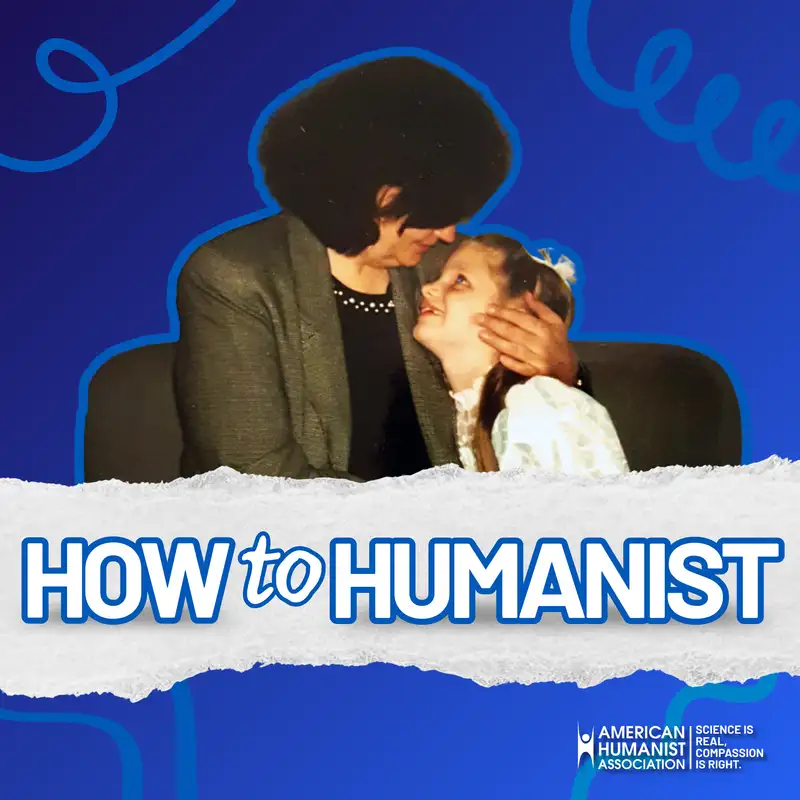
So to rewind the story: I grew up in Jersey, right outside the Bronx. Because Jersey is very different from New Jersey. Anybody that's from Jersey will tell you that. My parents, who were from Los Angeles, had a very long, rich history of Judaism. In our immediate family, we were Reform Jews. And my mom spent her life very much expressing that she wanted to become a “better Jew,” whatever that meant.
When she passed, naturally I wanted to follow suit. I wanted to tribute her in all the ways that I could find, which meant, okay, I'm on board. Let's become better Jews then. But I didn't know what that meant. All that she had demonstrated in her lifetime was how to be better to one another.
So I was already kind of, in a way, living humanism through what she had demonstrated — which now, in retrospect, I realize. I think my mom was probably a humanist also, but just didn't know it.
I don't want to speak for somebody who's not here to speak for themselves any longer, but just knowing her day to day.
Okay, let's put it this way. There's a story where I believe it was my third birthday, and my mom knew how to put on a birthday party. I mean, all of the friends in the neighborhood were invited. She made all of the snacks, all of the goodies. She came up with all of the games that we would play. She knew how to entertain the adults and entertain the kids. She was just the hostess with the mostess.
At one point, we move inside the house to have cake. My birthday's in July, so naturally it was probably sweltering heat outside. Maybe it was even an ice cream cake. I have no idea.
But anyway, for whatever reason, we end up inside my tiny little house. Everybody — and I only know this because it was on videotape, and I think it's so magical that this moment was caught on videotape.
Someone knocks on the door.
The video camera pans to the door because we're not expecting anyone. Maybe it's a friend, but everybody's already here. Who's knocking?
It's a Christian children's book salesman. He's going door to door trying to sell these Christian children's books. And my mom, a Jewish woman, is seen at the door talking with him for maybe a minute. Next thing you know, she has convinced him to come inside the house and read the book to the kids at the party.
Did my mom care that this was a Christian children's book? No. She didn't care.
Next thing you know, on the home video, there's a shot of the guy eating cake with us. My mom had offered him cake. This was who my mom was.
I knew from her very bold example, from the little bit of time that I had with her on this earth, that it was of utmost importance to treat people with respect, with dignity, with kindness, with generosity, with compassion. To offer them help whenever they needed it.
This was the 90s, so I can't even tell you how many times my mom would pick up a stranger on the side of the road. I wouldn't call it hitchhiking, but if she saw a young woman waiting at a bus stop by herself at night, she wasn't going to let that young woman stay there. She would say, "Hey, let me drive you wherever you need to go."
And my mom wasn't good at directions, mind you. So sometimes this involved her stopping home, getting directions, and then figuring out a way to drive this woman home.
I remember all of the delis we would go into each week when she would stock up on her chicken liver and all that stuff. Every time we went into the deli, she would say hi to every single person behind the counter, including the people in the back in the kitchen. She knew their names. She knew what was going on in their families — their wives' names, their kids' names. If there was a birthday coming up, she knew.
Her legacy for me has always been about how we can be kind and available to other people, especially when they need us.
Now, I didn't know that that was humanism at the time. But when I saw the job posting from the American Humanist Association, I knew on a very gut level I needed to be there.
But here's the thing. When I arrived in this world of humanism, yes, what I was learning felt aligned with what I needed from community and what I believed in. But at the same time, I felt like I was so far behind.
I didn't tell anybody at the organization this, but I was kind of whispering on the side like, "Hey… who is Thomas Paine?" Because I wouldn't dare admit that — especially to the Executive Director, Fish Stark, who is like the biggest Thomas Paine fan to ever live.
I didn't know who these historic people were. I knew about Frederick Douglass — didn't know that he was a humanist. I knew about Octavia Butler — didn't know that she was a humanist. I knew about Bill Nye — had no idea he was a humanist.
So all of these people that had such a massive part in the history of this country and where it's arrived to today — and yet I had never heard the word humanist uttered in my entire life until 2025.
What was going on?
So I definitely felt behind. But I also thought, there's got to be more people out there like me who are maybe dancing with the idea of, hey, humanism sounds like it's right for me. But I don't know. Maybe atheism has better marketing or whatever it is.
I just felt like I wanted to be the one to be the surrogate here for asking those quote-unquote dumb questions that a lot of us feel like we have when we approach anything new.
So I'm really honored. But I also want to be transparent — because I value transparency.
I'm scared shitless.
Do you know what a big deal it is to be handed the reins to host a podcast for an organization like this?
So I want to thank my team for supporting me in this endeavor. I have done podcasts before, but they've been listened to by maybe five people. I don't know how many hundreds or thousands of people are listening to this episode.
Hi. Nice to meet you. Nice to have you.
That being said, I'm a very sensitive creature. There are some environments on these internet sound waves that aren't very nice.
So I would really ask you — especially while we get the wheels turning on this podcast. Sometimes it takes podcasts a little bit to nestle into their groove, and it very well might be that way for me.
One of my favorite things about humanism is that we do not police one another about what humanism is. What it has to be is what will serve the betterment of each other and humankind.
So before you leave a nasty comment about "that's not true" or "that's not how humanism is done" — ask yourself: are you speaking to improve the air? Are you offering something constructive?
I am going to be so beyond happy to hear your feedback throughout this entire process. I want to loop you into this experience. This podcast is yours. It's for you.
So if you feel strongly about something I'm saying or something a guest said that you don't agree with — yes, please find a nice way to say it.
At least at this phase, I don't want to shift my focus in therapy right now to "people are being mean to me in the comments." Let's not screw with my therapist's plan. Let's just ride the wave in a nice, constructive way.
The final thing I will say is I really appreciate any opportunity to talk about my mom.
I want it to be understood that while I am the host of this podcast, while I am representing the American Humanist Association, the only reason why I am even here today — and the reason why I am who I am — is because my mom did such an impeccable job demonstrating day in and day out what it meant to be good to other people.
And so, with that, I hope you all enjoy the podcast.
I'm going to be asking questions that I have — that I know I've heard other people have. And I want to know what questions you have about this thing that very well may be brand new to you: this concept of humanism and what it entails.
And I really, really hope that you enjoy the guests that we bring on, because we are starting off strong.
The very first episode right out the gate is someone who fell into that bracket of "Who the hell is Greg Epstein?" That was me. And now nearly a year later, I'm like, oh my gosh, I can't believe that I didn't know about this guy. He's amazing.
So he's going to be our very first guest. And the reason I decided to bring him on is because he is a wealth of knowledge around the history of humanism. We had such a fascinating conversation.
I'm not going to spoil anything for you, but please know — if you have any feedback, we have an email: podcast@americanhumanist.org.
I would be happy to hear from you. I would also love to hear any compliments or well wishes or "cheers, keep going." Those will mean a lot.
But what will mean even more is you leaving reviews for this show. Because if we want it to be heard by as many people as possible, reviews count. Sharing these episodes with your loved ones counts.
On that note, I'm going to go grab some coffee.
Make sure you subscribe. These shows are going to be coming out every Monday. We hope it's the highlight of your day.
I really look forward to getting to meet you all and hear from you.
This is exciting. I love trying new things.
It's scary as fuck, but man, is it rewarding.
All right. I'll see you soon.
Listen to How to Humanist using one of many popular podcasting apps or directories.