 Episode 4
· 01:01:17
How to Humanist
Guest: Sammy of Haram Doodles
Recorded on International Women's Day
------------------------------------------------------------------------
SHAY: It is another great day to be a humanist. I'm Shay Leonia, and you're listening to How to Humanist. We are back with another episode, but before I get into today's guest, I'm playing around with the idea of reading comments and reviews from you all — only if they're kind, of course — because this is an opportunity for us to not only launch a new segment of the podcast, but also for me to briefly stroke my ego.
So I'm going to start by reading a review from Ambi Verbal. They title it "Great Introduction to Humanism." Thank you. They write: "Shay Leonia may be the perfect person to host this intro to Humanism podcast." I am blushing. "She has talent and enthusiasm for communication, and simultaneously she's learning about humanism along with the listener. When editing the show, she breaks into the interview to give background info — answers to questions that puzzled her. Given the broad spectrum audience this podcast is targeting, having both an expert and a neophyte covers many of the bases."
Now, Ambi Verbal, I truly appreciate this review, but why would you use a word like neophyte that I'm going to have to look up? I'll spare you all from sharing what it means. Let's just get into the guest.
Please do continue to leave reviews and comments because we really want to grow this podcast and get it in front of as many listeners as possible. We suspect there are about 45 million of us out there — just in this country alone — who don't realize they're humanists. So definitely hit that share button and leave a comment.
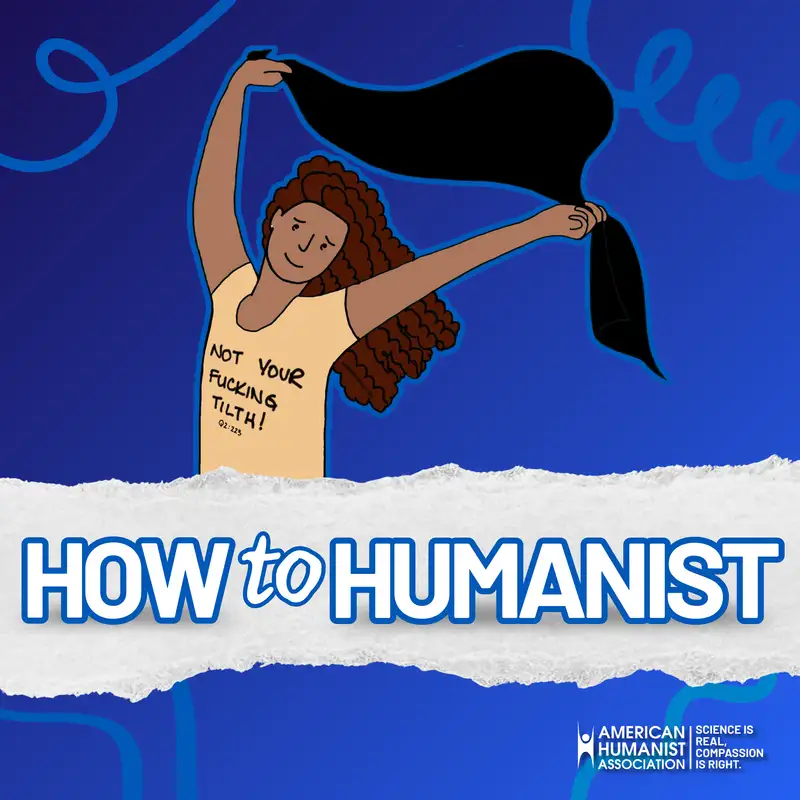
Today we brought on Sammy from Haram Doodles. Her account is filled with the most incredible doodles — little drawings she does online — that share her story, her experience, and other ex-Muslims' experiences of leaving Islam.
Something I really want to make sure we highlight, because it doesn't come up until the end of the episode: Sammy is seeking to promote the website freebetty.org. Her friend Betty Lachgar was seen wearing a shirt that caused quite a stir, and after visiting family in Morocco, she is now serving 30 months in jail. She's a cancer survivor and she is not doing well. Please take every action you possibly can at freebetty.org. Thank you in advance. Let's get into this episode.
------------------------------------------------------------------------
SAMMY: I've been doodling for four years now, and in the last two years I've gotten a lot more comfortable showing my face — just because I was done being scared. I really wanted people to know there's a person behind all these doodles.
It was never about me. I never made it about me. But I needed to make sure people knew that it was a woman, and that I'm not a child doing these drawings. They are very childlike drawings, but —
SHAY: I mean, it would be a talented child. Don't get us wrong, that would be a very skilled child.
SAMMY: Totally fair. But yeah, I got to this point where I was just so done being scared — scared of all the things we're told to be scared of. I needed to get my voice out there in different ways.
SHAY: What were some of the things you were told to be scared of?
SAMMY: It started in childhood. I was told to stop drawing, because drawing people and animals — living beings — is sinful in Islam. It's forbidden. That's why you see so much Islamic art built around motifs of flowers, petals, leaves, and geometric patterns. You couldn't draw living beings, so that art style flourished in the Islamic world. And a lot of children were just out of luck when it came to using their imagination, their creativity, that self-expression that is such an innate human thing.
[SHAY interjects: This was so wild to hear. I was always the kid at the diner who would flip over the paper placemat and spend five to ten minutes asking my siblings, "What should I draw?" I can't imagine not being able to draw whatever you wanted.]
When I was told to stop drawing as a kid — to get serious about life and Islam, to be a better Muslim — I was told, "How dare you mimic Allah? How dare you mimic the things He is the creator of?" Being told as a child that you're going to hell for drawing living beings, that Allah will ask you to breathe life into them — how dare you?
And as a kid, you're like, "I just wanted to draw." But the seriousness of it hits you. I took all of my art materials out from under my bed and threw them all away. I had to get serious about life — which meant becoming a lot more religious over the next few years.
It was a really sad moment in my childhood. Letting go of something I was so obsessed with. But coming back to it as an adult, coming back to that childhood love of drawing with a purpose — to support ex-Muslims and the ex-religious community — that gave me so much joy.
SHAY: How old were you when you were told you couldn't draw anymore?
SAMMY: Right around puberty — twelve, thirteen. Once I got my period, it was almost like overnight I felt a shift in how I was being treated. I was a kid up until that point, and then suddenly I became a woman. I think a lot of us girls experience that jump.
SHAY: All of the victim-blaming just rushes in.
SAMMY: Yes. The purity culture is very deep. A lot of Muslims believe that Islam came along and gave women rights that no other nation or country could. For the seventh century — and that's a hard maybe, more like "not at all" — sure. But there is also this claim, found in the Quran, that girls were being buried alive in pre-Islamic Arabia and that Islam came along and stopped that practice. Meanwhile, there is no data that backs this up.
I feel like girls continue to be buried alive — under layers of purity culture that asks you to lower your voice, stay home, not dress certain ways, not show your hair, not show your body, get married at an early age, because women were apparently born from and for men. I think we all notice that seismic shift once we hit puberty — very quickly realizing that our life is supposed to be about getting married and having children. But when you're taught that as a kid, you're indoctrinated into thinking that's where your value lies. It's all about pleasing men, serving men, being obedient to them.
SHAY: I grew up Jewish, but we were Reform Jews, so orthodoxy and Hasidism were very foreign to me. Can you share what type of Islam you were born into?
SAMMY: Sure. My family is Sunni Muslim — the majority of Muslims. I call it the "Sunni Muslim privilege," because we are the majority, and the majority calls the shots. That's also why we see a lot of persecution of other sects of Islam, like Shia Muslims and other smaller groups who are marginalized within the Muslim community.
I came from a Sunni Muslim background, but I had family who had married into other communities, so I had Shia family members, and non-Muslim family members too. It was interesting — some of the family around me weren't too worried about religion, and others were very focused on being Sunni, on being Muslim. It was such a huge part of identity. And it's hard to separate, because ethnically I'm South Asian. My family is originally from India and migrated to Pakistan during the Partition in 1947. We've been immigrants ever since — the Middle East, then the US. Being ethnic and being religious were so intertwined and deeply rooted in each other.
For clothing, for example — I wore Pakistani clothes, but they had to cover my entire body. No sleeveless, no shorts, no skirts above the ankle, nothing form-fitting. If I was visiting religious family, I had to cover my head. At the mosque, I had to cover my head. While praying, I had to cover my head. And I had issues with all of those things. I kept asking: why? Why don't the men have to cover their heads? What's wrong with my hair?
SHAY: Was that your own reaction, or were others in your family also questioning?
SAMMY: Definitely other family members were leading the way of, "I don't really care what Islam says, I'm going to do my own thing." The majority of my family's women actually didn't cover their head or wear hijab. But what's interesting is that after moving to the US — I was around seven years old — I saw a shift in the way Muslims here were practicing Islam.
I think immigrant parents often feel they have to double down on their culture and religion more when they're in the US. They're in a new land, a new country that doesn't speak their language or practice their religion, so they lean in harder on their identity. My dad was strict about speaking Urdu at home — and as a kid I was annoyed by that, but I'm really grateful now that I can still speak Urdu fluently.
I also noticed that the girls around me at my American public school were wearing shorts and tank tops, and they weren't self-combusting in the street. There was no fire raining down because they were showing their hair. That cognitive dissonance started building very early.
Religion is like patriarchy's baby, in a way. Here is how to live your life, here is the one God who will tell you how to do it, and here is the one book that will answer all your questions — and by the way, God is a man, all the leaders were men, all the prophets were men, all the authorities were men. They were the ones creating and perpetuating religion through every means available, including colonization.
I grew up in a low-income neighborhood, surrounded by a lot of diversity, going to a very diverse public school. Seeing people around me living differently helped me deconstruct my own life. What do they have that I don't? What can she do that I can't? Why can't I stay after school and join basketball? Why can't I play violin? That kept coming up: why is my life so different from everyone else's?
SHAY: Wait — you weren't allowed to join extracurriculars?
SAMMY: Part of it was that we weren't wealthy, so some of it was, "It's a waste of money." But part of it was also, "We don't know who you'll be with. We don't want you hanging out with boys. We don't want you hanging out with non-Muslims." So there were a few layers I was trying to navigate.
I was also sitting in class or on the bus wondering: why are my non-Muslim friends going to go to hell? They're such nice people. I kept visualizing them literally burning in hell, and going, "Is God really that cruel? Just because they're not Muslim, He's going to burn them? Just because they don't present as cisgender and heterosexual, they're going to hell?"
I did that questioning entirely inside my own brain, because I was too scared to ask out loud. I was scared I'd go to hell just for having these thoughts. I'd be thinking: Allah, please forgive me for even wondering why my gay friend, my Jewish friend, my Christian friend, my Hindu friend — why are all of them going to hell?
SHAY: And the wildest thing to me is that all of them were probably wondering why you were going to hell. Everybody's sizing each other up to see who's going, and in what capacity.
SAMMY: I know! If only they knew — they're so nice. I wish they wouldn't burn in hell.
SHAY: So during all of this — are you dressing modestly, or are you wearing hijab?
SAMMY: For us at home, I didn't have to cover my head, but my shirts had to end at a certain length. No shorts — always pants. If I wore skirts, they had to go down to the ankles. Clothes had to be loose so your body shape wouldn't show. And you get this narrative that men can't control themselves, so you have to cover yourself — that you as a woman, just by existing, tempt men. And you hear that everywhere. It's not just Islam.
So to be a good Muslim girl, I had to be modest, pray five times a day as much as I could, and avoid talking to boys — which is difficult when you're literally doing group projects at school and in college all the time. I still talked to the boys around me because I was seeing healthy relationships and healthy communication everywhere. Not every guy is out to assault or rape someone. These things don't just automatically happen, especially in schools and workplaces where there are laws that protect everyone.
By the time I got to college, I was questioning everything. What's interesting is that as a child, I had started questioning my mom — asking her why dinosaurs weren't mentioned in the Quran. Second or third grade, learning about fossils, millions of years old, found all over the earth — and I wondered why Allah didn't mention them if they were such a big deal. When I asked, I was told to stop asking questions. Whatever was in the Quran was it, and there were no other questions to be asked.
That was the moment the first seed of doubt was planted. There's something really odd here. That cognitive dissonance started very young.
I think if I had been a boy, I would have continued down that path of reasoning and critical thinking. But because I was a girl, once I hit puberty it shifted from reasoning to: you're a girl, you have different rights, different freedoms, and this is how you're going to live your life. If I were a guy, I think I would have had a much easier time of it.
By the time I got to college, I started taking courses on Islam. Surprisingly, my university had a lot of classes available, and I thought, "Easy A." They ended up being some of the hardest classes I'd ever taken — harder than my actual major. My background is in mass media, communications, and marketing, but I was also studying sociology and religion. I was really interested in how people come together, how they support one another, how they create systems. And I was studying religion at the same time, and these two things came together very neatly.
Religion is a way sociology operates — a system in and of itself, with laws, beliefs, practices, language, morals, all packed in. But at the center of it, I was told it was God. It was becoming clearer and clearer to me that it was actually men at the center.
Taking those courses, learning very objectively about Islam — the history, the wars, who was leading them, how treaties were formed, how people were captured — I quickly realized that the Islam I was taught was very different from what I was now learning. You grow up being told "don't do this, it'll please Allah," but these courses were about how wars happened, how people were enslaved. There was a massive history of Arab Muslim slavery — a slave trade that ran much longer than the Christian European slave trade. I kept thinking, "How did I never know any of this?" I felt manipulated. How was this held from me?
That's when I really started pulling away from religion. I went into an agnostic Muslim phase. At the start of college I was praying five times a day, going to Muslim Student Association meetings, forming relationships. But halfway through, I started pulling away and thinking: something doesn't feel right, and I need to figure it out on my own.
Meeting my atheist ex-Muslim partner really pulled me further in that direction. It took another seven to ten years to fully let go of Islam, but it led me down a path of very deep questioning. Why are things written the way they are in the Quran? Why are men given the right to hit women, to discipline women? Why are men given the right to marry four women? Why can a man say "divorce" and it's done, while a woman has to formally request it? Too many questions kept coming up.
Meeting my partner gave us both a safe space to talk about Islam, to deconstruct together, to compare notes. Shit, you too? Me too. We also learned how differently Islam operated for men versus women. He was already asking those questions in his own family — "Why are the girls in my family getting different rights than I am? How come I can go to college abroad and they can't?" We both had that safety to question, and to deconstruct Islam in a way neither of us had been able to before.
SHAY: I need the green flag guy from TikTok to roll by right now.
SAMMY: Green flags everywhere.
SHAY: So I saw a movie about ten years ago that haunts my dreams to this day. It's called The Stoning of Soraya M. A husband who's been cheating on his wife accuses her of the affair so he won't be punished — and a good half of the film depicts the actual stoning, including her own children being made to throw stones. It was devastating.
I find myself tiptoeing around this as a white American, wanting to defend Muslims given how prevalent Islamophobia is, while also holding space for you and the ex-Muslim movement. Where is the balance?
SAMMY: I would actually caution you not to use the word "Islamophobia."
SHAY: Really?
SAMMY: As ex-Muslims, we don't have an irrational fear of Islam. We have a very rational fear of Islam. "Islamophobia" takes away our right to criticize the religion — the ideas, the system, the beliefs that harm people. The words that actually describe what Muslims experience in the US and other Western countries are anti-Muslim hate and anti-Muslim bigotry. Those words describe what's being done to people.
"Islamophobia" conflates Muslims with Islam. Islam is a set of ideas, a system, a religion. Muslims are a group of people. Of course we should not treat people horribly. We should not discriminate against them. We should be checking our biases. But to equate the two — to say you can't say anything about Islam — how are victims and survivors of that system supposed to talk about it?
For us as ex-Muslims, we find ourselves stuck between two sides. On the right: "How dare you leave Islam, and how dare you talk about it publicly." Both are forbidden — apostasy and blasphemy. Apostasy means leaving a religion. Blasphemy means saying anything even remotely critical of Islam. That's why there are still countries where the punishment for apostasy and blasphemy is death. Muslim countries have cherry-picked which parts of Islamic law to incorporate into government, and anti-apostasy and anti-blasphemy laws exist because Islam explicitly forbids both.
To have these conversations, we have to separate ideas from people. Muslims experience discrimination and hate and bigotry in non-Muslim countries because they're immigrants, migrants, refugees — minorities, and minorities are marginalized everywhere. I've experienced anti-Muslim hate. My family has experienced it. Being called a "sand n-word," or being asked if I worship camels or cows by kids at school who couldn't tell if I was Muslim or Hindu but knew I was brown. That's real, that's awful, and no one should have to go through it.
But on the other side, we as ex-Muslims rejected this ideology. We pulled ourselves out of it because we don't accept it. We don't accept seventh-century laws telling us how to live in the twenty-first century. We should be able to talk about this. In the US, you can make a joke about Jesus. ChatGPT can make a joke about Jesus and can't make a joke about Muhammad — that's literally bias built into the product, because the people building these tools are building their biases into them.
Ask ChatGPT to make a joke about Jesus. Then ask it to make a joke about Muhammad. See what happens.
SHAY: I wouldn't even know where to begin with a good Muhammad joke.
SAMMY: I've drawn him and I have not gotten killed for it yet. I operate with a little bit of privilege living in the US, and I've had to use that privilege to support my ex-Muslim community and the ex-religious community at large. I also consider myself an atheist and a humanist — and honestly, it was through the American Humanist Association that I found the word "humanist." Finding the word "atheist," then "ex-Muslim," then "humanist" — those three viewpoints came together for me. I reject Islam. I don't believe in gods. I believe in humans. It was such a simple epiphany. Oh shit, that's exactly who I am.
------------------------------------------------------------------------
Ad: The radical religious right is fighting a war on empathy. It's bullshit. America needs more empathy, not less, and 80% of Americans agree.
We're launching the American Empathy Project to restore empathy as a core American value. We are giving out a hundred thousand dollars in grants for Americans to organize projects that help their neighbors. On May 2nd, we're going to have over a hundred American Empathy Projects across the country that you can join in your community.
They call empathy a sin because they want us to turn away from each other. The only way they can get away with their cruelty and greed is if they break us apart — because they know that when we take care of each other, they lose.
Humanists have always believed that science tells us what's real, and empathy tells us what's right. If there's a war on empathy, we are on team empathy, and we're going to win.
If you want a grant to lead an American Empathy Project in your community, or if you want to know how to join one in your community, sign up at the link. Empathy is not a sin. It makes us strong, and it's the greatest threat to authoritarianism.
They're betting their hate will overcome our humanity. We're betting that our humanity will beat their hate.
See you on May 2nd. Learn more at americanempathyproject.org.
------------------------------------------------------------------------
SAMMY: So we should be able to talk about religion. People can make jokes about Christianity and talk about all other religions in all kinds of ways, but for some reason people give Islam a free pass. And we're asking why. "Islamophobia" is essentially an anti-blasphemy law being implemented in civil conversation. People use it casually as if it's just normal language, and I'm going: stop. You're taking away our right to talk about our own survival out of that religion. We're trying to change laws. We're trying to speak up around the world for people who have been harmed by beliefs rooted in authoritarianism and supremacy.
Islam teaches that Islam will be the only religion left when the world ends — that everyone will become Muslim. So there is a supremacist framework built into it religiously. It almost becomes a biological identity when it isn't one. You did not inherit Islam genetically. It is a social identity that is learned over time. You are socialized into that system.
SHAY: I just want to thank you in advance for dealing with my white ignorance on this. I want to find a safe way to respect what ex-Muslims have endured and escaped from, without seeming like I'm committing anti-Muslim hate. I wouldn't even know where to begin.
SAMMY: It depends on context. For example, there is an Islamophobia Act being pushed through — I believe Ilhan Omar and Cory Booker are behind it — and the intention is good. They're asking for discrimination against Muslims to stop, asking for people to treat Muslims as humans. But you can accomplish that same goal using "anti-Muslim hate" and "anti-Muslim bigotry." The minute you use the word "Islamophobia," you are no longer talking about fear of people — you're saying we can have no fear of an ideology that doesn't work for the twenty-first century, that doesn't work for human rights, and that was created before human rights even existed.
We can respect people who follow a religion because belief is personal. But the minute religion is pulled into government — the minute saying anything about Islam is equated to attacking Muslims as people — that's not true, and it's not fair.
SHAY: I keep equating it to criticizing Israel versus questioning the validity of someone's Judaism.
SAMMY: Exactly. So here's a concrete example. When I look at my doodles, there's a recurring theme around hijab being a choice. Here's how I think about it: if you're having a conversation with a Muslim woman about her right to wear whatever she wants, then yes — that's about the woman's choice to dress however she pleases. That is a real choice. My mother wears hijab. I'm not going to treat her differently because of that. If a woman tells me I have to cover my head because I'm Muslim, I'll tell her to do whatever she wants with her own head and not to tell me what to do with mine. She has every right to present herself however she wants.
But here's the distinction: if she's wearing hijab because religion is commanding her to, that's not actually her choice — that's the religion's command. An expectation is not a choice. A demand is not a choice.
When conservative Muslim women in the US say "it's my choice to wear hijab," they're talking about their right to dress however they want — and that's valid. But when we're talking about the ideology itself, the hijab was introduced by men into Islam to distinguish between free women, enslaved women, and believing women. Veiling as a practice actually predates Islam — Zoroastrians, Christians, and Jews did it, as a mark of class and piety. Muslim men brought that practice into Islam.
In the Quran, the verse addressing men on modesty is two lines: lower your gaze, guard your private parts. The next verse, addressing women, is ten lines — detailing exactly what must be covered. I'm literally counting the number of rules for women versus men, and the data bias is right there. There are objectively more rules placed on women than men, even around something as specific as the hijab.
So yes — it is absolutely a woman's choice to dress however she wants. And it is their choice to follow whatever their religion says. But when you look at the religion itself, it is not a choice. It is a command.
I had issues even with covering my head while praying. Why do I need to cover my hair for Allah when I'm praying directly to Him? What is this hair fetish? Why do we have to stand behind men to pray? Women can't lead prayers. Women can't make the call to prayer. It has to be a man's voice. I had issue with all of that.
SHAY: And it all seems rooted in — God forbid a man catches feelings for a woman who's already someone's wife.
SAMMY: It's creepy.
SHAY: What's the difference between the hijab and the burka?
SAMMY: I think it's partly different cultural practices. In Pakistan, for example, we had a piece of cloth called a dutta or a chaddar that you'd wrap around yourself to cover the body — not form-fitting, nothing visible. The burka is essentially a different form of hijab. I think every ethnic culture practiced it a little differently. Even within my family, there were very conservative women and very liberal women. But I didn't see many women outright say, "Forget it, I'm done with Islam" — because it is so scary. The fear of losing your family, the fear of being killed, the fear of being disowned and isolated. All of that comes into play.
A lot of my family and friends don't even know I do this. As they find out, I'm available to talk. But I have no need to tell them unprompted — they're not my target audience.
SHAY: Do your parents know?
SAMMY: No. My dad passed away a couple of years ago. My mom doesn't know, and I know she's not going to be okay with it. I'm actually worried her health would deteriorate if I told her. I do have a family member who has completely disowned me because of this — she's simply stopped talking to me altogether. It is what it is. The most I can do is use the privilege I have to support my community.
That's why I take what I call a humanist approach to my doodles. Not being allowed to draw animals and people as a child, and then using that as fuel in adulthood to draw anything I want — pigs, animals, humans — and humanizing the experience of leaving Islam. What is actually happening to people? What do they hear when they ask questions, when they're deconstructing? What do they hear from family and friends? I wanted to give ex-Muslims a voice to talk about these things.
SHAY: I want to commend you, because I've also lost family from being vocal about my views as a Jew supporting freedom for Palestine. I'm sorry to hear that — and I hate that we both know what that pain feels like. But to know that we're doing it for what we believe in, and for the ability to help others, is incredibly powerful. I'm so grateful you're out here doing this work.
I was looking at exmuslim.me — can you talk more about that?
SAMMY: Sure. Since I started Haram Doodles four years ago, I've been hearing from ex-Muslims around the world who just wanted someone to listen, to have a space where they could talk and let everything out. Haram Doodles is really me vomiting out everything that had been on my mind for years and years. I think we all need to do that — get it out.
I kept hearing from ex-Muslims who wanted to share their stories but couldn't tell anyone. Some followers even use VPNs to access my account because it's banned in Pakistan. The Pakistani government has literally banned my account along with other ex-Muslim accounts. I'll take that as a moment of pride.
I knew there was an ex-Muslim subreddit growing year over year since 2010. There are people sharing their stories, people creating accounts like Apostate Aladdin, Secular Jihadist, Infidel Noodle, Zara Kay, Maryam Namazie — people who, quite frankly, helped me grow a bigger pair of ovaries to start Haram Doodles in the first place.
But I felt there had to be another way for ex-Muslims to share their stories. I wanted to literally put them on a map — because we get a lot of dismissal and gaslighting from Muslims who say, "You don't really exist," or "You were never really Muslim," or "You just had bad parents." I know ex-Christians and other ex-religious people hear very similar things when they're deconstructing.
A couple of years ago, I came across the website Queering the Map. I fell in love with it — putting little messages of joy and existence on a map, showing that queer people exist everywhere in the world. That idea sank into my head.
Then one day my partner mentioned he owned a domain called exmuslim.me and felt we should do something with it. I thought: what if we did what Queering the Map did, but for ex-Muslims? We ran with it. He helped build the website. We put security controls in place, ensured there was a private and safe way for people to share their stories, and we launched it on December 1st for ex-Muslim month.
We now have almost 500 stories — from countries that actually have apostasy and blasphemy laws: Indonesia, Malaysia, Iran, Iraq, Saudi Arabia, Pakistan. I have goosebumps talking about it. It was everything I had imagined accomplishing.
We get dismissed from both sides of the political spectrum. The political right loves ex-Muslims because we confirm their anti-Muslim biases — but that's not who we are or why we do this. And then there's the regressive left, who tell us to shut up because they think we're harming Muslims by talking about Islam. We're not. Why is anyone so offended and fragile about a person who actually experienced something in leaving it? Being able to talk about that experience — that's just survival.
We came out of a very abusive system. We came out of an abusive relationship with a narcissistic God. We said: this is the end of that relationship. I no longer want God to tell me what to do. I would rather make those decisions for myself and turn toward humans for answers. We don't want religion in governments — and that's exactly what is starting to happen here in the US. I never wanted to go back to my country of origin because it is so deeply religious. And now I'm watching it happen here. Where is the freedom of and from religion that we were promised?
Freedom of speech and freedom of expression are forbidden in Islam. That's why we can't talk about it. That's why we're not allowed to leave. And these Haram Doodles have been cathartic in the same way exmuslim.me has been cathartic for so many others.
One ex-Muslim wrote that he had waited 40 years to share his story, and this was the first time he had ever actually written it down. He had been too scared to say anything for that long. I just cried. Because that's exactly what we need — to give voice to people who have largely been told to be silent, told they cannot exist. And yet here we are. We exist. And we're fighting back against ideas that are anti-human at their core.
I'm really grateful for the amazing team of ex-Muslims around me who helped test the website, helped figure out how to moderate the stories safely. I've now personally read nearly 500 stories, and every single one is relatable. Every story makes you think: yep. It's been an amazing experience, and I'm so glad it's been helpful.
SHAY: I'm still left with so many more questions. I feel like I'd love to have you back for a part two — if you'd come back?
SAMMY: I'd love to.
SHAY: I have to thank you for all of the work you're doing, and all of your bravery and vulnerability. You're just magnificent.
SAMMY: Thank you. I really appreciate that.
SHAY: You're so impressive. I'm in awe of what you've been able to achieve.
SAMMY: Thank you. And if you're ever navigating these conversations, reach out. Let's talk.
SHAY: I'll be the white girl with questions about Islam.
SAMMY: Please do. I talk about Muslim fragility the same way we talk about white fragility — it's the exact same thing in a different context. Over here, we talk about white supremacy and the systems created by the white majority. With Muslim fragility and Muslim supremacy, I'm talking about the systems created by Muslim religious authority. We have to be able to discuss that.
I'm really grateful — thank you so much for having this platform, for speaking to humanists from all different walks of life. Humanists are not a monolith. Atheists, ex-Muslims — none of us are a monolith. We all have such unique experiences. Knowing that we have the power to support one another and change the world — that's what keeps me going.
And thank you for having me on International Women's Day. What an honor.
SHAY: Right? Total accident on my part — I'm putting that on you.
SAMMY: Thank you for having that date available in your schedule.
And I want to take this opportunity to say: we are fighting for our friend Betty Lachgar in Morocco, who has been in prison for six months simply because she wore a t-shirt that read "Allah is a lesbian" — a play on the feminist saying "God is a lesbian," but written in Arabic. She posted a photo defending her right to wear it, defending freedom of speech and of expression and freedom from religion. She was in Morocco visiting family. The Moroccan government has imprisoned her and charged her with blasphemy. Her sentence is three years in prison plus a fine. She has now spent six months there and is not doing well. She's a cancer survivor who needs medical assistance she is not receiving. She has been placed in isolation as punishment for years of fighting for human rights in Morocco.
This is how anti-blasphemy laws operate — they silence women for taking feminist stances. God can be anything. God can also be a lesbian if you want. That's why I'm wearing this shirt. I want more people to know about Betty. We should all be able to stand against anti-blasphemy and anti-apostasy laws without apologies, without excuses, without giving religion a free pass to do whatever it wants.
Organizations like American Humanists, Ex-Muslims International, and the Freedom from Religion Foundation give me hope. All we can do is keep trying. As Betty said: we have to keep fighting until we have freedom.
Thank you, American Humanists, for being here and for giving people the words to describe how they feel about life — the idea that we can help each other, that we can actually center humans when we create systems and laws and policies. I'm really grateful.
SHAY: I'm going to let you enjoy the rest of your International Women's Day.
SAMMY: Thank you, Shay. It was really lovely talking to you. I hope we get to speak again.
SHAY: I would love that. And I have to say — I was so nervous going into this. I was like, this could go really badly. This very mayonnaise-y organization talking about ex-Muslim month.
SAMMY: Thank you for inviting the Worcestershire sauce into the mayonnaise.
SHAY: What does that even make?
SAMMY: Trust me — I like chutney better. I'll be the chutney to your mayonnaise. Whenever you have questions like this, reach out. I have people contact me with random questions all the time, and I'm more than happy to help.
SHAY: Chutney Moments. That could be a whole segment.
SAMMY: I love that.
SHAY: All right — talk soon!
SAMMY: Take care. Bye!
SHAY: Bye!
Listen to How to Humanist using one of many popular podcasting apps or directories.