 Episode 31
· 36:15
AD:
If you've been following How to Humanist for a while, you probably enjoy hearing humanists talk about humanism. The American Humanist Association's 85th Annual Conference is coming up on September 19th and is another chance for you to do just that. Our speakers include pioneers in the progressive content creation space, like Monte Mader and Barrett Paul, as well as former podcast guests like Dr. Monica Johnson and Faith Litchfield. Whether you care about fighting for our right to a secular democracy, championing life-affirming progressive values, or fighting for a world in which everyone can find joy and belonging, the conference has something for you. Join us online on September 19th to celebrate our shared humanity and be in community.
Visit americanhumanist.org/conference to register. See you there.
SHAY:
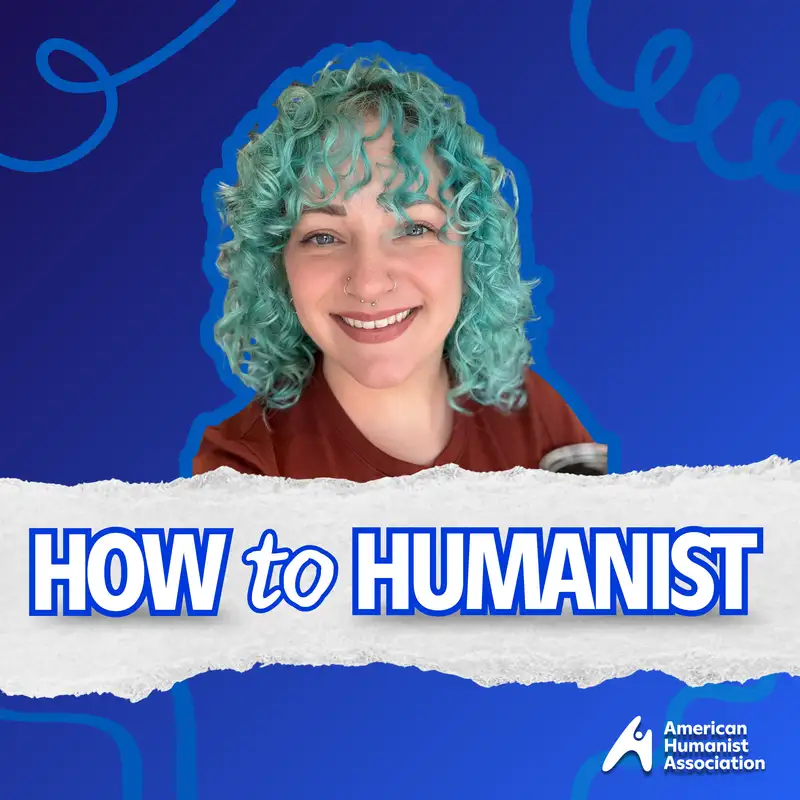
Welcome back to How to Humanist. It is your host, Shay Leonia, again, on behalf of the American Humanist Association. Today, we are celebrating 30 whole episodes of this podcast. So thank you very much for joining me on the ride of learning about humanism as somebody who is a brand new humanist, as well as learning just overall how to become a better human.
I have got to insist that you take a look at your calendar right now, in case you haven't done so already, and mark September 19th. If you're hearing this on the day that this comes out, it will be September 14th. So we are just five days away from our annual conference. It's gonna be our 85th annual conference.
Oh, there goes my oven.
And it is going to be completely virtual, which means that if you haven't been able to join us for a conference before, now is the time. We wanna see you in the virtual room, in the, what is it, Lin-Manuel Miranda, the room where it happens. Oh my gosh, don't come for me, Broadway fans. But anyway, we want you there, and you will be getting to witness all of the latest ideas and concerns and shared opinions of people in the humanist space, including people like Monte Mader, Barrett Paul, former guests on the podcast like Faith Litchfield, Dr. Monica Johnson, and so many more. And we just want you to be there.
Now, today, to celebrate the 30th episode, I am actually going to release an episode with the permission of my lovely host, James Hodgson from Humanism Now. I got a chance to be on their podcast, and they were kind enough to say, "Hey, let's let everyone know about it."
So I hope you enjoy this episode because it's really a testament to where I'm at in this journey of being a brand new humanist, and I know that I might listen back to it years from now and be like, "Oh, wait, no, that's not as humanist as it could be." But we're all works in progress, and I just hope that you get all cozy and enjoy this episode.
JAMES:
Welcome to Humanism Now, a podcast about secular ethics, curiosity, and compassion. I'm your host, James Hodgson. Our guest this episode is Shay Leonia. Shay is the communications manager at the American Humanist Association, where she also hosts their podcast, How to Humanist. Shay also runs AHA's Creator Program, which partners with content creators to bring humanism to new audiences. A lifelong musician based in Philadelphia, Shay has found humanism fairly recently, and she came to the movement the same way that she hopes others did: curious, a little confused, and glad she stayed.
Shay Leonia, welcome to Humanism Now.
SHAY:
Thank you so much, James.
JAMES:
It's a real pleasure to have you with us. I've been thoroughly enjoying the How to Humanist podcast, and I know that you have a background through your own media work and media company that you founded, and that storytelling is very important to you, and that really comes across in the interviews that you facilitate.
So maybe we can begin at the beginning for you as well. Could you tell us about your upbringing? And I know you came to humanism recently, but what were some of the values that were instilled in you and have stuck with you from your early years?
SHAY:
So I grew up in Jersey right outside the Bronx, and I had an unusual family dynamic in that my siblings, there's a massive age gap, and my parents were much older.
But one of the things that I truly appreciated about being attached at the hip to my mom all the time was witnessing how she interacted with people. Whether she had met them before or not, she was going to learn every detail about them, whether their kid had a birthday coming up or it was their anniversary. Anything from the dishwasher in the back to the person that was giving her change at the register, she just knew them all by name, and everyone looked forward to seeing her. And I think that was probably my earliest witnessing of humanist values.
I remember still, I mean this was in the '90s, so it wasn't as scary of a thought as it is now, but if my mom was driving past a bus stop and saw a woman sitting by herself waiting for a bus, my mom would just ask her, "Where do you need to go? I'll take you." Which was hilarious because she was horrendous at directions. So this was before the days of MapQuest and GPS, but she would just figure it out just for the sake of somebody not having to be by themselves, and the whole ride there she would learn about them, and it just continued.
So I think that very early on, I learned what it was to be good to your fellow human, no matter who they are.
JAMES:
So there was a curiosity and I guess just a sense of collective community growing up. Did faith play a role in your... 'cause I know you've talked about how you're discovering humanism fairly recently, but was faith or the questions around these topics of religion play a role in your early years?
SHAY:
I wouldn't say the question so much. I was raised Reform Jewish, but there was always this desire, especially from my mom, to be a quote-unquote "better Jew." And we were all very well aware that we were Jewish. We were doing the high holy days at home, and never quite made it to the synagogues, but there was like a short stint in Hebrew school for me.
But every value that I know today to be humanist, we were, in my family, attributing to Judaism. So we thought that they were exclusively Jewish values. Not to say that we didn't witness those values in other faiths, but it didn't ever even occur to me to be non-theistic. It just wasn't a thing.
JAMES:
And so fast-forward, how and when did you first learn of humanism?
SHAY:
Through the job posting. The job posting at American Humanist Association. I first saw the communications director role became available, and I saw the job description, and I was like, "This is hilarious. I have got to work here." And I did not get interviewed for that role, but they kept my name on file, and so when the communications manager role opened up, I was asked to apply, and now I'm here.
But yeah, it wasn't until the interview process where I was like, "This really resonates with me. I've never heard of humanism, but is this what I've been all along?"
JAMES:
So was it a case of genuinely, to your recollection, never hearing of humanism, or more that there was a misunderstanding of what the term meant?
SHAY:
Yeah. No, I know that it's used in different contexts today, but I had genuinely never heard of humanism. I'd only ever heard of atheists.
JAMES:
Did you feel that sense that a lot of people have, that they read around, they dive into it, they read about it, they understand what humanism is, and then you get that light bulb that says, "Oh, this describes what I already am"?
SHAY:
Absolutely, yes.
JAMES:
And I love that you're going through this sense of learning and discovery in this public way, right? I recently had Seth Andrews on the podcast as well, the host of The Thinking Atheist, and obviously he's been podcasting now for sort of 15, 20 years. But what's really interesting is he went through a similar thing of, he came out of being a true believer himself, and then doing this deconstruction and discovery in a public forum, and I'm always curious about doing that.
So what have been some of the main learnings for you? What have you discovered most by having these conversations and coming to humanism, as you said, with this sense of curiosity and a little bit of perhaps apprehension as well?
SHAY:
There have been so many different things that I've been learning. I think publicly what others might and I hope are learning, because my conversations aren't exclusively with non-theists. And at first there was a little bit of pushback from listeners around that. I've had people email us and say, "Why do we need to talk about theism at all? We don't really wanna hear about other religions. We have to hear about them day in and day out. Why on the podcast?"
But I think that, A, to pretend that we don't live in a world that has other belief systems, I think is not authentic, and authenticity is something that's a very important value to me. But also, I think that if we shut ourselves out from the opportunity to learn from others, then it's not us practicing humanism in its truest form.
Humanism never claimed to be something that we want to evangelize to the masses. I think we, as humanists, just want to talk to the 45 million people or so, at least in the United States alone, that are probably just like I was, a humanist, but didn't have the terminology to put to it.
The other thing that I've really grappled with, I think there was an episode that I did with Alyssa Rosoff that from the beginning I was very apprehensive about, because I'm somebody who has always struggled with the good riddance of bad people, you know, reaching the end of their term here on Earth. And so when I decided to be a humanist, I was like, "Oh wait, that's not very humanist of me."
So having to have that conversation with not just Alyssa, but to his credit, my executive director and former guest of yours, Fish Stark, being able to really learn the reason why that is not something that we, I don't wanna say believe in, but stand behind. I think really just being able to see the value in humanity, the value in reform, people's ability to reform, especially when that's cut short. I think to kind of balance that equilibrium across the board, to believe that people in prison can reform, and to believe that these people that are trying to squelch the rights of those that we care about can reform.
I think we need to be able to understand that there is that chance for them, and to celebrate their abbreviated ending is not necessarily the way to go.
JAMES:
I agree. So this is interesting then. So would you say that whilst maybe you did feel an immediate kinship with humanism when you came across this role and learned more about it, do you think it has encouraged you to question some of your other beliefs that you hold, and hold them up to what we might call humanist values?
SHAY:
Absolutely. I think one of the hardest things, I discussed this with Greg Epstein on the podcast, one of the hardest things for me to let go of was the notion that my mom, who has passed on, is the reason behind anything good that is happening in my life. He put it so beautifully because he's also experienced this with his father's passing.
That was probably the last semblance of belief system that I had left in the supernatural, and I didn't wanna let it go because it very much felt like letting her go. But Greg was absolutely wonderful and compassionate in being able to help me reframe it as a nice thought to have, and that I don't have to let go of that as a thought, but to also know that at its root it's a thought, and it's a nice little fantasy and a way of thinking about it.
JAMES:
That episode in particular is very moving, and you're very willing to have these raw emotional, as you say, you sometimes have the self-critique and invite listeners to do the same. I think that's what's really compelling about it. What surprised you most about podcasting, or interviewing, as you say, a wide range of people on what they believe and having those very honest conversations?
SHAY:
This might be a more technical answer than you were looking for. It's actually the way that we ended up doing the... Well, I keep saying we, I'm being so generous with that. The way that I ended up doing the podcast, I've hosted podcasts before, and I've had two different podcasts that I hosted, and they were very straight to the point, just interviewing, put it out, and it's done.
With this one, I wanted it to have the space for me to admit to the audience when I don't know something, and I was really struggling with, how am I gonna do that? And so that very first episode, I was up at probably 2:00 in the morning. It still wasn't done. I was putting out that one and the Greg Epstein episode at the same time, and I was like, "How am I gonna do this?" 'Cause Greg is saying so many things that I don't know what the heck he's talking about, and I want the audience to not feel like, oh, Greg's such a smarty pants and Shay's feigning the same.
So I just decided to have a little fourth wall break. Kudos to my musical theater background and my training there. But I just decided to break the fourth wall with the audience, because I think the thing that I experience from day to day is that I'm not an academic. There are frequently going to be wonderful words that I hear on a day-to-day basis or wonderful theories and practices that I've never heard of, that I just want to pause time for a second so I can get a better understanding myself of what that is. And it took me a while to get there, but it's something that I'm no longer ashamed of.
I've finally realized at this stage in my life that everybody's learning something. And so I really wanted those in the audience who are gonna be on the same page as I am and not be academics and not feel like they're being spoken to over their heads or being condescended to, to have a moment, to have a breather, to learn what I'm learning, and to see if they have anything more to contribute. Because I love the fact that they can leave comments or reviews or reach out to us and let us know if something resonated or if they wanted me to dive deeper into something.
JAMES:
That's a really lovely part of the podcast as well, that you do have those little intermissions, those little inserts and tags where you let the audience know kind of what your thought process was or if you had to do some additional research or provide the background. I know exactly what you mean as well.
I've had academics, we try to have a range of guests here on Humanism Now, and I may be quite well prepared and have read the book prior to the interview, but you have to accept that, understand that the audience hasn't, and you have to act as the proxy for the audience, right? I think we are talking to a very curious and generally well-informed audience, but as you say, everybody is learning in different ways, and every guest is bringing something new that audiences won't have heard before.
And so I really admire that you're going through this process publicly in the way that you are and are willing to say when you didn't understand something. Because I think, I'd imagine people will empathize with that and should almost themselves say, "Okay, yeah, I didn't get that piece either. I'm glad that Shay said that there." Because as you say, it can be a little bit overwhelming, and we can be, in humanist circles, sometimes a little bit too academic when we're explaining what we believe.
SHAY:
Yes, we can. It's something that I work on, that we work on with Fish a lot. He's absolutely wonderful at being accessible, but sometimes we need to just poke him and remind him to be a little bit more accessible.
But yeah, those academic stick-swinging conversations can get to be a little bit much, and it makes it feel so much more distant from what humanism should be when we land ourselves in those debates. I mean, I know that debates are necessary and exchanging of these wild thoughts that people are having, especially if they've been mulling over them and reading all of the books and studying all of the greats.
But some of us just wanna know how to be nice to one another. Some of us wanna just know, okay, if I'm feeling introverted, how can I be a little bit more extroverted and talk to somebody online at the cash register? So I just don't want to leave those people out in the wind, like humanism too often feels like it does. I feel like we've gotten a little bit further away from what the roots of humanism are.
JAMES:
No, I think so. And in terms of making humanism more accessible, you're also supporting others. I know that you lead the Creator Program at AHA as well. Could you tell us a little bit more about that and what the aims of that project are?
SHAY:
Yes. I have, not lifelong, but like for the existence of the internet in my lifetime, I have long admired content creators. I've wanted to be one myself, still inching my way forward there. But we were given the opportunity, thanks to donations, to be able to work with influencers, primarily in the secular space, which is where we started with the creator program, with creators like Drew McCoy of Genetically Modified Skeptic, and Alyssa Grenfell, who discusses her being an ex-Mormon.
So many different people that were already in this space with audiences that may not know about humanism. And so the goal was to, once again, even the playing field on how good, unfortunately, the right is on whether it's red pilling people or just getting them into their hemisphere through content creation. They've been wonderful at that, kudos to them. But we need to balance those forces out, and we also needed a way to reach younger audiences.
So I think that this accomplished so many things at once that we, some things that we didn't even anticipate. But what we've been able to do with the creator program is balance it out by not just working with secular creators, but also starting to delve into creators that are adjacent to the space, where living a secular life might not be their niche in their content, but they are clearly displaying humanist values.
And so I reach out to them and I shoot my shot, and we've had some wonderful partnerships come about in that way. Barrett Paul is someone who we get to work with, who made the really impressive claim, and we're so grateful and honored, that his whole Love Army movement has been rooted in humanism. And so these are creators that we are not just working with in a transactional way, where we're just sponsoring their videos and calling it a day. These are people that we are really truly considering partners and, not to be cliche, but like family in a sense to American Humanist Association, because we want to help them the same way that they're helping us to get the word out about humanism to their audiences.
JAMES:
And I love this angle as well, that it's not, you're not looking for people who are making expressly humanist content and saying, "Okay, we want people who are already within the tent and are talking about the things we want." But actually, it's building these broader coalitions, while staying true to your values. And so, have you found, what have been some of the results that you've seen from that, both in terms of the relations with the creators themselves, and perhaps they're compelled to talk more about humanism or identify more with it in their own content. Or at least, as you mentioned, do you call it the Love Army?
SHAY:
Yes. Barrett Paul's Love Army.
JAMES:
At least when we're talking about the Love Army, hopefully the people see there is a huge correlation here and that we've got some overlapping objectives. But also, are you finding that people are finding AHA and other humanist groups through supporting these creators?
SHAY:
We absolutely are. Year one has really been about just gathering data on, I think, more of how the creator program needs to work in a sustainable way. But now that we're closing up year one, I'm really excited about year two, because that will give us a chance to really hone in on these systems. And what we've found is that I can really get the opportunity to take advantage of the differences between the creators, their audiences, their styles, what their audiences are ready to hear, what they want to hear.
We have creators whose audiences are so engaged and enthralled with everything they say, and they know they're so rooted in their values. One creator's name is Eric, he goes by Go Unstuck Yourself, and I found him on TikTok because he had a swell of new followers, and he decided to reintroduce himself, and I happened to see that video. And in that reintroduction video, he said, "Just so you know, this is what I stand for," and he listed all of these values that were so supremely humanist, and I had to reach out.
And so we got the chance to work with him, and when he put out a video about humanism and he was spreading awareness about this religious liberty coalition, I hesitate to call it by its name, the result was his comments were flooded with people that were saying either, "Oh, I love humanists," or, "Oh my gosh, am I a humanist?" There was literally somebody that commented, "Damn, did I just learn that I'm a humanist?"
And I love seeing comments like that, because while it's wonderful to get people from a warm audience like Drew McCoy's who have probably already heard of humanism but would love to take the next steps in supporting our work, there are people that still need to learn what humanism even is.
JAMES:
But I think that's so smart what you've done there, because as you say, there are some people that have just not heard of humanism, and then there's plenty of people who I think have a bit of a misapprehension about it. And at the end of the day, a lot of people are like, "It's not important to me right now." They're much more concerned with whether it be politics or social issues, or obviously science communication has exploded on YouTube, which is fantastic. And all of these are things where, as you say, there is a clear relationship and a clear connection with what we're advocating for at humanism.
So it's nice to have a warm introduction from someone that they already trust, giving people, I like this phrase, I think it comes from Anthony Pinn, to give people a soft landing, right? You're not hitting them over the head with humanism.
SHAY:
I very much think that what the creator program is, and this is gonna be the most non-academic example I could give. So I'm vegan, and I often find that when I speak to somebody who has tried veganism and they'll say, "Oh, yeah, yeah, yeah, I tried veganism, yeah, I tried X product," or, "I tried X restaurant." And I'm like, "Oh, you tried one of the ones that's not so good, no wonder you didn't like it." And what this creator program does is it gives you a chance to go to the best restaurant.
You're hearing from a creator that you already align with, that you already follow, you already trust. And so we're getting a co-sign from the right place rather than you potentially running into somebody who sometimes unfortunately we do encounter on our social media pages, most of which are trolls. But somebody who might be not supporting trans rights or somebody who considers us to be going in a bit of a hippie direction, whatever that means to them. But I would rather that they encounter humanism from someone that they adore rather than somebody who is close-minded and somehow still considering themselves to be a humanist.
JAMES:
I think it's definitely the case. I think probably alongside attending a ceremony, hearing about it from someone who you already know and respect is probably the number one way that people find out about what a humanist or what humanism is.
And I wonder, in some of those conversations, and now that you're in an interesting stage for me, Shay, because obviously you're still like a baby humanist, so I...
SHAY:
Yes, I'm just learning to walk.
JAMES:
Exactly. And I love the curious awe that you bring to it as well, as newborns have. But are you also seeing now what some of the misunderstandings of humanism are and the common misconceptions that you end up having to deal with, that probably those of us who are sort of occupied in, you know, fully in the circle, we may not realize how we sound to other people?
SHAY:
Yes. Humanism has predominantly been a white academic space. Despite there being plenty and massive amounts of BIPOC humanists, we have not done a good job at creating a welcoming space for them to work in tandem with them and to really have them feel truly integrated into humanism. And as I'm saying that, I hear myself almost implying as though white people are the gatekeepers of humanism, which is not the case.
But I think what we do is a little bit hypocritical at times, because as I said with the episode with Greg Epstein, we really got into the nitty-gritty of how humanism does not like to consider itself to be policing one another. While we do have these root values, we don't like to police one another, and so I think when we close ourselves off to variables of humanism, I don't think it bodes well for the rest of us.
So I'm saying all that to say that what I've encountered is a bit of disjointedness from the humanists that have been our veteran humanists, who are, again, very well-schooled and thought on all of the books and all of the greats that they've heard of before. But then there's the people that are new to humanism that might need that bridge of their current theism to get to a point where they eventually develop into secular humanists.
And I think that I haven't seen as much tolerance of that as I would like, and I also haven't seen as much open-mindedness about the differences in thought and the necessity of us showing up for BIPOC humanists as there needs to be. So I'm really hoping to see humanism reform in a way that kinda, for lack of a better phrase, gets with the program, because there are some people that do not want change, but without change, we die.
So we need to be able to open our minds up in the same way that we were open to accepting humanism in the beginning from the start, because there are people that are being left out of the conversations that we need to be looping in.
JAMES:
100%. And I really believe as well that if we want humanism to be broadly accepted in society, then it needs to reflect society. And this is a problem that we've seen certainly in the UK as well, with some improvements certainly. But yeah, it absolutely has to, and that means opening your eye, opening up to the issues that younger people in particular, I always think, listen to younger people and what are the issues and the terminology and the language, and to go back to your creator program, where are they getting their information from, and what are the issues and people that they want to associate with?
SHAY:
Absolutely, yes.
JAMES:
And with that, what role would you like to see the AHA or humanists more broadly playing in American society?
SHAY:
I want to see AHA leading that reform. I'm so excited about where we're headed. It's interesting because even our staff represents the meeting of the new and the old. Not to call anybody on my team old, but we had such an influx of new staff and new board members that came on just within the past just over a year, and so we're able to learn from one another about where we've been, where we need to go, and it's really exciting to be able to work with a team that is so forward-thinking, regardless of where they are on that spectrum, and really being able to bring ideas and put them on the table and really examine them.
I think one of the things that I value most at AHA is that we have weekly calls with staff where we get to really dissect, what are we each seeing on social media? What has been headlining for us lately? What has been important to us? And it could be something as seemingly frivolous as a TV show, or it could be a trending headline. But either way, we're all bringing it to the table, and if we find that there are patterns or things that feel very urgent to us, we bring them forward, and we share it with our audiences.
So I'm very hopeful about where AHA can really lead the charge on really reforming humanism.
JAMES:
I really admire your approach as well with the podcast, I think with everything that you're doing, that you are looking outwards much more and not focusing necessarily, of course we're here to serve the humanist community and represent non-religious people or secular people, however they want to be defined. But that you're looking for your cues outside, as you say, responding to news, what's been trending, what's actually affecting people's lives.
SHAY:
Mm-hmm.
JAMES:
And that should lead how we engage and we campaign.
SHAY:
Yeah. Because humanism is not, again, humanism is not this everlasting academic debate. It is how we are able to use these values that we're learning from humanism to approach these everyday questions. How are we approaching AI? How are we approaching sex trafficking? How are we approaching the genocide in Gaza? How are we approaching all of these different things that we need to be able to speak on and to be able to look at through a humanist lens?
JAMES:
And what's your advice for listeners, let's say we have listeners who are comfortable associating with the term humanist and maybe do struggle to engage with people we would consider allies but are not accepting of the label, the term themselves. 'Cause you're clearly brilliant at this, of getting people on board with the ideas and the concepts without saying, "Okay, are you gonna sign up now?"
SHAY:
Yeah, I would never wanna do... Well, that alone, thankfully, I've had an extensive practice as a Jew to not have to evangelize. So I would never claim to wanna start evangelizing now. But I've done some interviews with people where I've asked them if they've heard of humanism, what they knew about it, and at the end of the interview, once I hit stop on the recording, they say, "You know, I would love to identify as humanist, but..."
And it's really interesting to get that kind of focused research unintentionally on learning what is making people hesitant. Some people don't like applying labels to themselves, period, because they don't wanna be restricted to whatever anybody else's perception of them might be. Or they feel like they don't wanna, quote-unquote, "break any rules" and be called out on it. They just find that it's easier to not adhere to a label while still inherently feeling like they are humanists.
There are other people who still have certain things that they feel like they might be shunned by humanists if they were to admit aloud that they still like people that are into astrology. I mean, these are real-life examples that I've had from the people that I've gotten to speak to on the podcast, and I can absolutely appreciate it. But I think that gives us an opportunity to then take that feedback and do better at making sure people don't think that we're gonna wag our finger in their face when we learn things like that. So that's really given me that chance to learn.
JAMES:
To listen more.
SHAY:
Yeah.
JAMES:
And as you say, don't come at it from a judgmental... I think that's what it's coming across, like there is a sense that people feel like they might have to adhere to certain rules. So broadening that a little bit.
SHAY:
Yeah. My best friend is, to her credit, who I also had on the podcast, Cheryl. Cheryl is very big on leading with curiosity, and I credit her to really dwindling down my knee-jerk reactions to judge anyone. She's very much like, "Okay, well, if you have this belief about something, let's lead with curiosity and ask questions and probe a little bit. And if somebody's brave enough to share the real truth with you, then that's a privilege, and take that as such."
JAMES:
Yep. We lead with curiosity and compassion, and I know the AHA has a slogan very similar to that as well. And minds do change slowly, so sometimes just having that conversation, as you say, somebody at the end of the interview may not say immediately, "Oh, yes, I'm fully convinced," but maybe the first cracks have appeared and they may well agree in time.
So speaking of minds changing, we have our standard closing question. What's something which you've changed your mind on recently, Shay, and what inspired that change?
SHAY:
I'm gonna go back again to the example that I gave with Greg about the role that my mom's memory plays in my life. I have, ever since that interview, thank you Greg, by the way, if you're listening, I have really been able to come to peace with that reliance on the supernatural idea of her being the reason why anything good happens.
It was such a sweet thing for me to hold onto, but it wasn't serving me in a way, it was in a way that would try to almost gaslight myself. I think that it's helped me be more honest with myself to realize that it was a nice thought and it was a nice way to commemorate her memory, but there are so many other ways to commemorate her memory. I have tchotchkes of hers all around. I have her Fiddler on the Roof album behind us and, you know, just so many reminders of her everywhere that I don't need to pretend in order to feel like she's still very prevalent in my life.
JAMES:
Shay Leonia, thank you for everything that you're doing at the AHA and with How to Humanist, and thank you for joining us on Humanism Now.
SHAY:
Thank you so much for having me.
JAMES:
Thanks for listening to this episode of Humanism Now. If you enjoy the podcast, please leave us a rating and review. And why not share this episode with a friend? It really helps more people hear about the show, and we're building a growing community over on Ko-fi. Special thanks to our supporters. If you would like to join them, links are in the show notes.
You can follow us on all social media at humanismnowpod, and thanks once again for listening to Humanism Now.
Listen to How to Humanist using one of many popular podcasting apps or directories.