 Episode 26
· 54:28
SHAY:
Welcome everyone to How to Humanist. I'm Shay Leonia, your host. If you're just now joining us at our 26th episode today, welcome. We're so glad to have you. Just so you know, I am a brand new humanist. I'm only a year in, so still a baby. And I have had the pleasure of having 25 so far, wonderful conversations with different humanists, different people who can teach me more about being a better human overall. And it has just been such a wild ride, and I'm still finding myself with so much to learn.
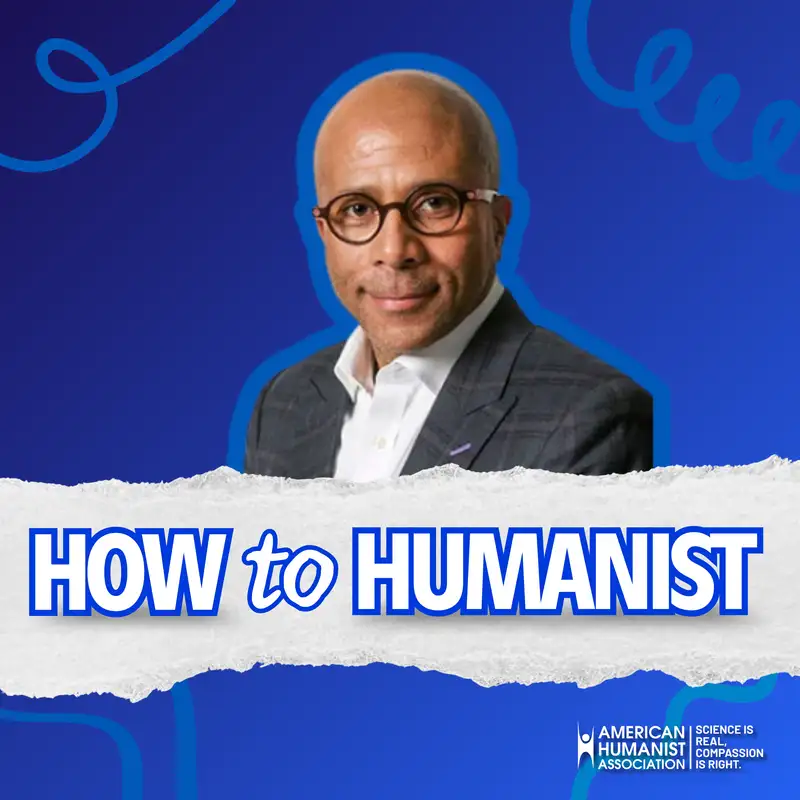
Which is why I'm so happy that today's guest is Dr. Anthony Pinn, who has such a reputation that precedes him. He is an Agnes Cullen Arnold Distinguished Professor of Humanities and Founding Director of the Center of Engaged Research and Collaborative Learning at Rice University.
He has been a longtime friend of AHA, and like I said, he just has this massive reputation. So I'm not gonna lie, I was definitely shitting myself when he was coming on the podcast. I didn't know what I was gonna talk to him about because he's just absolutely brilliant, and I am not quite finding myself in that realm just yet. Maybe one day.
But for now, what I can relate to you on is music. And so I was really relieved to discover that Dr. Pinn was actually on an episode of the Combat Jack podcast show. Now, this was a pioneering hip hop podcast that was hosted by the late attorney and executive and journalist known as Combat Jack. He unfortunately passed away several years back, but I have long been aware of the Combat Jack Show. I have a friend, A. King, who is involved in the show, and it was really interesting to hear Dr. Pinn as a guest on there because he brought on Bun B, who is a rapper based in the Houston area, and it was just fascinating to hear how he was able to tie in hip hop with religion.
So follow along on this windy road that Dr. Pinn and I are gonna take, because it starts off with hip hop, and it will wind up with the most massive call-out that all of us as humanists so desperately need.
SHAY:
I shouldn't be surprised by the six degrees of separation of it all, but I didn't realize that you were a guest on the Combat Jack Show.
DR. PINN:
Yeah. Oh my goodness, that was so long ago.
SHAY:
I'm good friends with A. King, who was the co-founder of that show. Condolences on the tremendous loss of Combat Jack. But I was listening to the episode that you did with Bun B, with him.
DR. PINN:
Yeah.
SHAY:
And I was stunned. Can you tell me more about that era? 'Cause I was like, "Oh my gosh, he brought Bun B in to teach?"
DR. PINN:
Yeah. It revolved around two things. So I've been teaching 32 years and have always incorporated hip hop into what I teach. I just think that's vital. But it really wasn't until I got to Houston that I had access to such a range of artists and labels. So many of the artists my students were talking about in class in Minnesota lived in Houston. And so rather than having hip hop as part of a larger class on popular culture, I started teaching a class just on religion and hip hop, and I would invite artists to come through.
And so one of my graduate students at that time was an intern at Rap-A-Lot Records, and so I wanted to bring Bun B in, right? 'Cause I was a UGK fan, I wanted to bring him in. And so she made the contact. Initially he was hesitant, you know. He just didn't see the point in doing it. And I told him, "I understand that. I get that. It's not as if Rice had really shown the hip hop community any love over the years." So I get that, but I was trying to explain to him we were doing things differently.
And so he finally agreed to come to class, and we had a chance to talk in my office, and it was clear to me this shouldn't be a one-off, that there was this major talent who was interested in the classroom and who had a lot to say. His thought was deep. So I invited him to co-teach the class with me. So we did that numerous times, but then we were invited by Rice to put together a MOOC, one of those massive online courses. We came to New York to publicize this, 'cause it was open to anyone anywhere in the world, and we wanted people to know about it, so we were on The Breakfast Club. Combat Jack was kind enough to let us come on and talk about it. So it was just a fabulous time.
SHAY:
I didn't know you were on The Breakfast Club. Holy shit.
DR. PINN:
Yeah, yeah.
SHAY:
That's so interesting. So this is our first time meeting. So I would love to give you a bit of backstory about how hip hop influenced my teaching.
I was assigned as a teaching artist for songwriting in the South Bronx, right by Grand Concourse. Literally we as teachers stood outside to make sure that the kids went home quickly because that's the corner where everybody's shooting. So in this classroom, which was predominantly Hispanic and Black kids, this was 2016, I was desperately trying to find ways to get through to them about songwriting.
And finally I realized, like, wait a second, I'm in the South Bronx, the home of hip hop.
[SHAY interjects: I need to incorporate this somehow. So we had Mad Skillz call in and talk to the kids a little bit, and then we started emulating studio sessions. So we would do freestyling exercises to work on their vocabulary. These studio sessions were so fun because the kids who were in sixth grade, they would get to sit on their desks and challenge one another on, like, "No, change this lyric," and then they would have to explain why. So they were able to express critical thinking, and it ended up being one of the most... I'm getting chills remembering it right now. But it ended up being such a transformative experience for me and for the kids. And I remember when I was unfortunately laid off because they deemed songwriting the same as singing, which was ridiculous, the kids were messaging me like, "Ms. Shay, we won the battle on the playground." And it was so wonderful. And so I just had to wear my Tribe shirt today knowing that I was interviewing Dr. Pinn, because I was like, oh my gosh, we need to talk about hip hop as it pertains to religion.]
SHAY:
I know you've done it a million times with these other shows, but nobody who's listening to this episode is gonna have that background probably. So let's dive in if you don't mind.
DR. PINN:
Oh, I'm game.
SHAY:
Okay, so please tell me your first foundational, the essence of why hip hop pertains to religion and vice versa.
DR. PINN:
So if we cut to the core, religion is really an effort to make life meaningful. It's an effort to wrestle with the fundamental questions of life. Who are we? What are we? When are we? Why are we? And there are so many ways in which hip hop culture is interested in the same questions, from a different vantage point, but interested in the same questions. And so it seems to me, in the same way folks will talk about Christianity or Islam being concerned with making life meaningful and giving us a way to process what is happening to us, hip hop culture does that for a different population.
SHAY:
Now what are, what are people that are missing... I don't even know how to word this, because it's so, it's a very racist thing to me. Like, it's the only genre of music when I hear somebody say, "Oh, I don't like that rap stuff." It's the only genre that they will say "stuff" about, because they immediately associate it with misogyny, with gang violence, with all the stuff that they don't wanna be associated with, and they're like, "Oh, no, I can't. That's not for me." But it feels very racist to me to say that.
DR. PINN:
And I think in all fairness, there are those sorts of elements within certain genres of hip hop, but people act as if hip hop created misogyny, that hip hop created sexism. No, that these folks labor in the gardens that we have provided. And in that way, hip hop is deeply American. It has all of the potential, the possibility, the beauty of us at our best, but also reflects on us at our worst. And so it seems to me rather than getting self-righteous, folks ought to listen and figure out what hip hop is saying to us and about us.
And they're completely dispelling the fact that there are other genres, rock and roll, that have the same qualities.
SHAY:
It's...
DR. PINN:
And I think, yeah, one of the differences is something you pointed to earlier, that this hip hop culture is dominated by marginalized communities, right? Kind of represented by what politicians some decades ago called super predators. So there's just something about the population that has given us this form that people find deeply troubling. And so rather than wrestling with the circumstances hip hop artists are speaking about, they simply attack the artist.
SHAY:
Kendrick Lamar constantly inserts into his music about reminding us about the era of them being crack babies. And I think people often think of these eras being so far off in the distance in our past. What are the consequences that these communities are still dealing with from those eras?
DR. PINN:
That kind of urban decay, the loss of resource, that has never gone away. It multiplies. These struggles continue, and again, it's easier for folks to simply blame hip hop rather than to wrestle with the circumstances that made hip hop necessary. What does Jay-Z say? "America, this is what you made me." So there's a sense in which hip hop simply reflects what the US has made available. So again, rather than going off on these artists, look at the circumstances they describe, and do something to make our social world better.
SHAY:
Who are you a personal fan of most? I wanna hear your top five.
DR. PINN:
Oh, see, that gets a little tricky.
SHAY:
I know, I get stressed out by the question too.
DR. PINN:
Of course I have to include on that list Scarface. I think Scarface is to music what Richard Wright is to literature. There's just a brilliance there.
SHAY:
Wow.
DR. PINN:
Tupac has to be on the list. I think that Queen Latifah has to be on that list.
SHAY:
Jersey.
DR. PINN:
Because there are ways in which Queen Latifah forced us to think about elements we were just comfortable assuming. She forced us to think about the way in which a kind of toxic masculinity got expressed within hip hop. She forced us to wrestle with who is authorized to speak. So I also have to include Public Enemy on that list, and UGK has to be on that list, right? Limiting it to five is hard 'cause I didn't get to mention Nas.
SHAY:
I know, I know. Right?
DR. PINN:
Or A Tribe Called Quest. Or Kendrick Lamar. And so it seems to me it's easier for me to say my top five during any given decade as opposed to overall, because the way these artists develop and influence others has to be taken into consideration.
But all that to say that hip hop is extremely powerful. If we just look at the way in which hip hop has come to dominate how we think and communicate globally, it starts with despised populations and despised urban contexts, and from those contexts, it shifts, it changes, and it dominates the globe. It's amazing.
SHAY:
It is amazing, and to think of the arc of where it started. 'Cause I am from Englewood, New Jersey, so Sugarhill Gang got their start there. So you look at acts like Sugarhill Gang and then the arc to where we are now.
I can't personally say that I'm a fan of a lot of the hip hop that I hear now. I'm almost hesitant to call it hip hop because I grew up in the '90s. I got to witness the great golden era. And so I am having to check my own biases about, like, are you actually listening to what they're saying? Are they all in a blanket sense not saying anything, quote-unquote?
But are you still in touch with what's out now?
DR. PINN:
Some, but I don't work too hard to stay current. It just comes out too quickly. And there are ways in which technology has just opened the floodgates. Anybody can record an album, anybody can make their music available, so it's hard to keep up.
But my thing is we don't have to personally find every artist engaging. That's okay. There are a whole lot of novelists that I'm not gonna read, but I wouldn't say they don't write literature. A whole lot of novelists I'm not gonna read, but I would never say what they have produced doesn't constitute novels.
Mm-hmm. It's just not my thing. It doesn't strike me, and that's good. I don't think we have to be okay with or committed to every genre of hip hop. Because it seems to me if that becomes our goal, then we lose our critical edge. We lose the ability to critique. And everything about the culture needs to not only be celebrated, but also critiqued.
My thing is anything we love, we want it to be better. So if we say we love hip hop, we ought to not only celebrate it, we ought to critique it in ways that allow it to grow and to flourish. We need to hold it accountable. Things I don't really care about, whatever. I'm not putting my energy into critiquing whatever. Do your thing. But hip hop, if you love it, how can you not want it to be better? And that means holding artists and fans and labels accountable.
SHAY:
Now, how do we transfer that accountability to something we love, like humanity?
DR. PINN:
It seems to me by again, kind of celebrating our potential, but recognizing all of the ways in which people have been horrible. Ways in which we have been horrible. And it seems to me this is, in part, what's happening in the context of the United States, is a kind of willful amnesia, that we are unwilling to grapple with all of the nastiness that has taken place.
And so folks will point their finger at Trump, and I think what he is doing is horrific, but they will point their finger as if nastiness starts with him. No. He just provides a rather crude model of a mindset that is deeply US. So what we see happening here is not the failure of the US system to work properly, it is the US system as it was intended.
And so what does it mean to have to wrestle with that? That we have systematically built a nation on marginalized and disregarded populations, and how do we do differently? So it seems to me this conversation concerning democracy on some level has to wrestle with this, that we have brutalized folks for the sake of this nation. How do we do better?
And I think one of the ways we get at that is to begin to ask ourselves a very different question, and that question is, who have we forgotten? What have we forgotten? On some level, it provides a certain type of humility in our thinking and our doing.
But we have to recognize that this nation has done some really screwed up stuff, and that this screwed up stuff isn't a marginal thing. It isn't an oops. This was intentional. This is part of the fabric of this nation, and what does it mean to recognize that and try to do better?
SHAY:
I've been hearing people online that are Black that are saying, about the fact that white people right now are up in arms about, "Oh my gosh, what are we gonna do? The world is on fire. This is a horrible time. How are we gonna fix it all?" When Black people have been experiencing fascism their whole lives.
I don't know if the white people that are listening to this episode are realizing that's the case. Is it just that we've had blinders on this whole time?
DR. PINN:
Yes, blinders on, and the name of those blinders is white privilege. We live within the context of a society that was built for white people, and built for white people at the expense of other populations.
So we tend to talk in terms of people of color, for example, that kind of phrase, and I don't really care for that phrase, because it allows whiteness to be normalized, 'cause we mean everybody but white people, so white people remain the norm. It seems to me it's more accurate to say people of a despised color, 'cause that's the situation. It's not simply that some folks are colored and others... No, there are certain colors that receive a tremendous amount of animosity and are open to violence, and we need to recognize that.
So yeah, I think there are ways in which white Americans are just waking up to circumstances because they're starting to hit home. But prior to that, no real direct consequences, not on the collective level. Individual whites, sure. But on the level of a collective, on the level of the white community, much of this had no impact, and so it wasn't of concern to them. It was easy to say, "Well, Black and brown people are doing this because they've lost sight of moral and ethical values." You just simply blame the victim.
Black folks and brown folks and yellow folks are experiencing this, and it's their fault. The American Dream works. But now white folks are getting hit in a very different way, and so now it becomes a problem.
SHAY:
Yeah.
DR. PINN:
So I understand the frustration. It's been a problem for us from day one, but you're now just catching up and pretending as if you've discovered something. No, you are finally feeling the consequences of something.
SHAY:
Well, why do we have such a bad habit of acting like we discovered something?
DR. PINN:
It's a certain privilege, right? It's white privilege within the context of a nation that has been decidedly concerned with white supremacy.
SHAY:
I've encountered some Black people who have said, and it almost feels like they're buying into the white narratives of it, where they'll say, "Yeah, but that stuff happened, and it's no excuse, and we need to push on." And they're basically giving the get over it argument themselves. And I'm just baffled, like, are we at the point where we're infecting the people that this was perpetrated against?
DR. PINN:
We assume that age decreases impact, and that is just not the case. If you look at the economic holdings of Black families over against white families, there's a marked difference. If we think in terms of opportunity for whites over against Blacks and browns, there are major differences. Selective universities and colleges are dominated by what population?
So there are still ways in which this legacy of enslavement and what that set up in terms of how we think about populations continues to inform and influence how we act as a nation. So the stuff remains real and is extremely impactful. Folks don't have to be in physical chains to be suffering the consequences of restriction, confinement, and lack of opportunity. It remains real.
SHAY:
One of my side hobbies is genealogy. I love doing genealogy for my family, and it's been a major eye-opener for me. How many friends I've asked, like, "Oh, let's do some genealogy," and they'll say, "You're not gonna find anything. I don't know where I came from." And it just makes you stop and realize like, oh yeah, holy shit, your family was stolen and brought here. Even that alone, just realizing the generational impact of that. I'm able to trace back and know that in Lithuania this person started it all, you know. But...
DR. PINN:
Yeah. I mean, it's to be part of a population that really has no home. Folks will, members of the African American community, be told I'll just go back to the continent. But the experience has been we go there and we are deeply American in ways that we don't even recognize, but they see it. There are ways in which we are just deeply American. And then in the United States, we're in a country that we helped to build in some real ways, being told this isn't yours.
So we live in a kind of in-between space, so we're hyper-sensitive to and aware of the way this country has operated. How could we not be?
SHAY:
I hadn't even thought about that.
DR. PINN:
And I think part of my frustration has been, and I'm a member of the humanist community, no doubt about it, but for a population that understands itself to be so logical, so committed to reason, so well-read, that the number of humanists who are willing to operate based upon stupid assumptions is just ridiculous.
SHAY:
Stupid assumptions how?
DR. PINN:
Concerning race and anti-Blackness, right? Just stupid assumptions concerning this. That, one, you wipe out all of the world's problems by getting rid of religion, and what they mean by religion is theism. As if you get rid of theism, you get rid of our problems. As if atheists and humanists and skeptics and freethinkers haven't done their share of dirt historically.
And I think too many humanists are not aware of the ways in which this sort of nastiness, anti-Black racism for example, informs and influences their sense of history. So for example, I've not encountered very many humanists who don't hold some regard for Thomas Jefferson. But as soon as we include Thomas Jefferson in this orientation, we have also welcomed in sexual violence and anti-Black racism.
And all that is to say that humanists have to be, rather than simply pointing their finger at churches, mosques, and synagogues, more aware of the ways in which the humanist tradition has contributed to the marginalization of populations.
The Enlightenment was not a friend to every population.
SHAY:
Yeah.
DR. PINN:
The Enlightenment didn't do Black folks very many favors. But there's a kind of uncritical embrace of the Enlightenment within humanist circles. And one way in which this comes across is this uncritical assumption of progress. This assumption that humans will get this done. Look around. Humans are capable of some really nasty, nasty, nasty, nasty things. So it isn't wise to make assumptions concerning progress, advancement.
And when we think about those things within humanist communities, the question becomes what populations are we putting at the center of that growth, and which populations are we forgetting about? Again, that question: who have we forgotten? What have we forgotten?
SHAY:
Yeah, progress for whom?
DR. PINN:
Yeah. And I think there are humanist communities that are not really open to hearing this. The number of times I've been told that I come across as so aggressive. And I think it really revolves around my effort to hold folks accountable, 'cause I don't hear my conversation being any more aggressive than Richard Dawkins or Sam Harris. But we're just talking about different things. I'm saying the humanist community needs to do better. I'm not content pointing my finger at theists. Humanists need to do better.
SHAY:
This is probably the first episode that I am recording that in real time I'm speechless and processing. Wow.
DR. PINN:
We have to do better, and we do better by first recognizing the misery that humanists have caused, and stop pretending as if we are above all of this.
SHAY:
Are you able to get a little bit more granular about that misery that we've caused? 'Cause I'm still a new humanist. I don't know a lot about this.
DR. PINN:
Well, it seems to me that it's not only theists who've been involved in the promotion, if not actively then passively, of anti-Black racism, of homophobia, of transphobia, of sexism, of classism. These are forms of violent marginalization that people have participated in, and not just theists. Humanists as well.
But to the extent humanists don't want to wrestle with those issues, or think inviting someone who looks like me to a conference to have us talk about it, raise some questions, then go about your business is all that needs to happen, that's not a fundamental change.
We have to do better. And it seems to me that non-theists have a greater moral and ethical obligation, 'cause we're not saying there's something up there telling us what to do. We're saying humans have this capacity, that this is a result of what we think and what we do. We are fundamentally and finally accountable for our thought, our speech, and our actions. Wouldn't that make us deeply responsible for doing differently?
SHAY:
It sounds like humanists are suffering from the same thing that is just wildly convenient for all of us to do, which is to just point the finger elsewhere.
DR. PINN:
Yeah. I think that's the case. And again, rather than simply pointing the finger at theists and saying it's their belief structure that has screwed up the world, ask this question: who have we forgotten? What have we forgotten? How do we exercise the best dimensions of our humanist thinking and doing to transform circumstances?
SHAY:
It's such an abstract question, at least as I'm... it's very overwhelming. I mean, forgive the free DEI lesson request, but where would we start?
DR. PINN:
Wherever we find ourselves. We start in the context in which we find ourselves. It seems to me it's really that easy.
So one way to start is at AHA gatherings, for example. As planning is taking place, this is a good time to ask the question, who have we forgotten? What have we forgotten? Within our local humanist gatherings, we ask the question, we're working on our programming for this year, we're working on our outreach for this year, who have we forgotten? What have we forgotten?
It's really simple. Wherever we find ourselves, however we find ourselves, we look for what's missing. On some level, it's simply an exercise of humility, an embrace of uncertainty. And I also think that humanists in particular, and folks in general, have to become more comfortable with discomfort. Kind of sit in that discomfort, rest in that discomfort, because it's at that point of discomfort that we are most aware of our assumptions, and best positioned to do something with and about those assumptions.
But we tend to move through the world with the unspoken request, "Don't make me uncomfortable. Don't push me."
SHAY:
I know that I personally grapple with the line between inviting them to the table versus burdening them.
DR. PINN:
Who's the them?
SHAY:
With the them being the Black people, the brown people. Having them be at the table and then having them potentially feel burdened by being the first person that we've invited, or somebody that we're really listening to when they speak up because we wanna hear.
DR. PINN:
A couple of things on that. I think there are ways to make it more productive. One is humanists need to do homework, so don't ask Black and brown people to come and teach you. Do the homework. 'Cause we're talking about a population that understands itself to be well-read, digging into information. Well, when it comes to these issues, don't be lazy. Don't ask these folks to come and teach you. Do your homework so that you can have a different type of conversation.
Secondly, don't simply invite folks into existing structures and existing assumptions. Rework how we do things so that their voices matter. If we're really gonna invite a diverse population in, we have to restructure how we do stuff so that they really are involved, involved in ways that allow them to help transform and shape rather than just be there and sit quietly. We gotta be willing to disrupt and redo in order to bring in new populations.
SHAY:
It's so funny because we constantly, as humanists, talk about the different ways that religion has infiltrated our everyday lives and our programs and just everything throughout America, and then we don't look at how whiteness has infiltrated the same.
DR. PINN:
Whiteness has been assumed. And again I think when humanists talk in terms of religion, what they really mean is theism, and I wanna make a distinction between religion and theism.
SHAY:
Yes, please.
DR. PINN:
Religion for me is a human system by means of which we wrestle with these fundamental questions of our existence. Who are we? What are we? When are we? Why are we? In that regard, I think you can make a reasonable argument that humanism is a religion, to the extent it helps us to wrestle with these fundamental questions. So it helps us to think those questions. It also involves action that is based upon how we've responded to those questions. And it also has, get this, ritual.
We tend to think ritual only in terms of churches, mosques, and synagogues. No, that's lazy. Ronald Grimes, a professor in Canada, years ago argued that ritual is repeated activity in founded space, so it's stuff we do in places we have created. So it seems to me every AHA conference is a ritual. It involves certain practices that are pretty much the same year after year, with folks involved in certain ways year after year. We get something from that gathering of community year after year. That's ritual.
So I don't think we do ourselves a disservice if we don't appreciate this dimension of what it means to be a humanist. 'Cause it's through this attention to ritual, for example, that we get at humanism as more than something we think. It's something we feel. It's something we do, not simply something we think. So we have to be real about what humanism means to us and how it functions within our communities.
SHAY:
Do you ever take issue or concern to people who would insist that it's not a religion?
DR. PINN:
My argument is most of the folks I've encountered who make that claim are thinking theism and religion are synonymous.
SHAY:
Right.
DR. PINN:
And they are not. So I would say yes, humanism is not theism. It is not theistic. It doesn't wrestle with these fundamental questions in the same way theism does, but that's a different thing than saying it's not religious. And for me, that's just lazy thinking. It's too easy. There is a distinction to be made between theism, the real target of our critique, and religion as a non-committed kind of process of wrestling, of trying to make sense of who we are and where we are. What humanist doesn't do that? What humanist organization isn't at least implicitly concerned with those sorts of questions?
SHAY:
Did you grow up as a humanist?
DR. PINN:
No. I grew up first, several years of my life, we were Baptist. And after that, my family, my mother's side of the family, we attended a non-denominational church close to my home in Buffalo, New York. That church became a part of the African Methodist Episcopal Church. So I grew up in that, and until I was 25 or so, I was involved. I spent about 12, 13 years in ministry, and came to humanism out of that. So I know a little something about both of these worlds, the world of theism and the world of non-theism.
SHAY:
What was the bridge that brought you over to humanism?
DR. PINN:
That everything I claimed, everything I preached, everything I presented theologically had no real impact on life for folks. And what I found myself being obligated to do was to help folks become more comfortable with their misery, in part because nothing about what I offered as a minister helped folks or even made it okay for folks to ask fundamental questions about God.
There's a question that people in the study of religion ask. Some folks call it the problem of evil. For others, it's theodicy. And basically it's this: what can you say about God in light of human suffering in the world? And my answer to that shifted and changed. I started out as a Christian who was in the world but not of it, evangelical, conservative Christian, and started moving towards a kind of Christianity that was more earthy, that was more concerned with what we do for people, and this was my effort to respond to that question.
But it reached a point where none of that was satisfying, and I wasn't convinced I actually believed anymore. And there were lots of things I was willing to be, but I was not gonna be a hypocrite. I was not gonna stay in a profession and advocate for what I wasn't certain was really healthy or helpful, so I left.
And for a while I wasn't certain what I was. I knew what I wasn't. I wasn't a Christian, but more than that, I wasn't a theist. My answer to that question, what can you say about God in light of human suffering in the world, became this: you can't say anything, 'cause God doesn't exist. It's just us.
And it was folks like Sharon Welch, who taught at Harvard Divinity School, and William Jones, who taught at Florida State University. These sorts of folks introduced me first to the Unitarian Universalist Association, but more than that, it was folks like William Jones who helped me recognize that what I was was a Black humanist, and that I was part of a long history, a legacy of Black folks who embraced this orientation. I was not alone.
SHAY:
I recently had the pleasure of speaking with Je' Exodus Hooper, and they were saying that humanism has a larger issue of claiming humanists that haven't claimed humanism themselves.
DR. PINN:
Right.
SHAY:
When you discovered that you were part of this long legacy, did you find that there were many that you had to deem, well, they've said these things, so they might as well be humanists, or had they actually said that themselves?
DR. PINN:
Yeah, I think they are absolutely right. We have to be careful in how we apply this label of humanists, in the same way we have to be careful in terms of how we apply the label of feminist. And so what I tend to say is many of these folks, we don't really begin using this label of Black humanism until mid-20th century. So all of these earlier folks, my argument is whether or not they called themselves humanist, they had an orientation towards life. They had a set of moral and ethical sensibilities and assumptions that are in line with what we call Black humanism.
So was Richard Wright a humanist? Well, it's not language he really uses, but his orientation, how he spoke about the world, how he spoke about humanity, is certainly consistent with humanism. Was W.E.B. Du Bois a humanist? He doesn't use this language, but so much of his moral and ethical thinking is in line with Black humanism. Was the writer Nella Larsen a humanist? Well, she doesn't use that language, but everything about her moral and ethical insights in that book, Quicksand, are consistent with Black humanism. Same with Lorraine Hansberry and A Raisin in the Sun.
Or think of someone like Alice Walker, who uses a variety of labels, but she accepted the AHA Humanist of the Year Award. Now, I would not accept a Christian of the Year award from the African Methodist Episcopal Church, 'cause it doesn't fit. So it seems to me something about this humanist orientation was consistent with her self-understanding.
SHAY:
Yeah. And we're still in 2026 now, still feeling that there are millions of people who don't realize that they are probably a humanist, because the word has just not been used effectively, the marketing has been bad, it's remained in whiteness and all of the other reasons that people might not be identifying as humanists.
DR. PINN:
And that's really important. I think in thinking in terms of African Americans, there are a whole lot of folks whose orientation towards life is consistent with humanism that are still in Black churches, not because they necessarily believe what the preacher is preaching, but because within the context of that church, there's a social network, there are cultural connections, nobody's asking them why they're angry. Nobody's rendering them exotic. Nobody's touching their hair without permission. So there's a kind of comfort there.
And so it seems to me the question isn't, why don't these folks identify as humanists? The better question is, why hasn't humanism been more appealing to them? Why haven't our humanist communities been more appealing to these folks?
In part because we're not giving them a soft place to land. It's not enough to simply critique these theistic communities. These folks know that there are shortcomings in these communities. They know this. But what do humanist communities offer as a viable alternative to a population that is already facing at least double jeopardy? And then to publicly claim to be a non-believer is to add yet another source of trauma. So what makes that worthwhile?
And we tend to point the finger at the victim. Why don't they come...? No. Why haven't we made this more appealing? And I think in part because there have been implicit assumptions that, one, humanism is very heady, and you have to be a thinker, as if Black and brown folks don't think.
We've not made this welcoming to folks, in part because of how we've understood humanism through a kind of elitism. But also we've been slow to embrace the issues that are life and death for these folks. So join your community when you're not talking about the stuff that affects me? Join your community when your thinking on Trayvon Martin was a little fuzzy?
So we have to make humanism more compelling. If we're not gonna make it more compelling, then humanist communities need to be straight up truthful and say, "We're not interested." If humanist communities really wanna diversify, they really wanna be welcoming to folks, then you gotta change. You gotta rework things. Don't ask folks to come in and fit in. Ask them to come in and help you restructure, rethink.
SHAY:
And pay them to do that.
DR. PINN:
Hey.
SHAY:
We encounter some of the most vitriolic, disgusting comments, particularly on Facebook, and I would love to be able to say that it's mostly trolls or it's mostly people that aren't humanists, but unfortunately it's a lot of humanists, or people that claim humanism.
And from my only recent experience becoming a humanist, I've been getting told by Greg Epstein and others that we don't like to police humanism, that we don't like to say that there are certain rules that you have to abide by. But it also feels confusing in the sense that there are people claiming humanism that are also vehemently against people that are transgender or people that are Black. We are literally getting called hippies in the comments for the direction that the new, I'll say the new wave of employees at AHA have been wanting to take humanism.
And it's feeling very much like a lot of people need their cards revoked.
DR. PINN:
I think we have to hold folks accountable, that this cannot be a free-for-all. That we have to hold folks accountable, that there are certain moral and ethical standards that have to be maintained. I think that's really important, but I also want to recognize that humanism is not a prophylactic against stupidity. That you can be humanist and have backwards thinking on social issues. But I think we need to hold each other accountable and responsible, and that this has to involve critique.
Otherwise, it's one-sided. We get to critique theists, but nobody gets to critique us? Come on now.
But I've never heard, and this is personal experience, I've never heard a humanist of a despised color saying, "Well, we're not gonna police this. People just say what they say and they do what they do."
I've never heard anyone from a marginalized community who is a humanist say that.
SHAY:
'Cause they don't have the privilege to.
DR. PINN:
Because they are so often the victims of this nastiness. No, they're not gonna turn around and say, "It's cool. Just say whatever you want to me. It's cool." No, they're not gonna say that.
SHAY:
Yeah, yeah.
DR. PINN:
So the question for me is, again, who have we forgotten? What have we forgotten? What kind of privilege is in place that allows folks to say, "Hey, we don't police this. Just say what you want"?
[SHAY interjects: Right? And folks will say that within the context of the humanist movement, but they wouldn't say that MAGA folks just get to say or do whatever they want. So an external critique is okay with us, but don't bring this home. Don't tell me what to say or do. And I think we often use humanism or atheism as a safeguard to be rude and callous. And we ought to be better than that.]
DR. PINN:
There's that self-righteousness that's so parallel with white thinking, with humanism.
And I think there are ways in which humanism has been a kind of privileged orientation that has really failed to see the ways in which it is an orientation that has been embraced by a diverse population. And it's not that folks in other populations haven't been humanists, it's that the central humanist community haven't been concerned enough to recognize them.
White humanists didn't bring Black folks into the movement. We've been thinking this way for a very long time. Listen to the blues. Read Richard Wright. Read the late James Baldwin, not just Go Tell It on the Mountain, the later stuff. Read an Alice Walker. Read a Zora Neale Hurston, who argued that prayer is for the weak. We've been thinking this and doing this for a long time, just without notice.
In part because too many humanists have assumed that to be Black is to be Christian, end of story.
SHAY:
Yeah, yeah. That's what I keep running into.
DR. PINN:
That's a problem. Yeah, a whole lot of Black folks have been Christian, but not all of us. And the historical record, if we allow it to speak, indicates there's been critique of theism within African American communities from the very beginning. Not everybody bought into this. And related to that, I think humanists often have limited insight concerning why Black folks embrace Christianity.
I will always get the question, why would Black people embrace a tradition that was used to enslave them? And my answer involves a couple of things. One, asking humanists why their orientation hasn't been more attractive to this population. Secondly, recognizing that we have to nuance this, that Black folks involved themselves in this Christian tradition for a variety of reasons, not all of them, "Hallelujah, I believe in God." Some of them much more pragmatic. So we have to be mindful of the ways in which Black folks also used this tradition to try to preserve something of themselves. Didn't embrace this idea of God, didn't embrace any of that stuff, but this was a mechanism they could use to their advantage. They were being pragmatic.
And I also think it is ahistorical to assume that Black theism has done nothing to push the United States to be better. You can't explain Mary McLeod Bethune that way. You can't explain a Martin Luther King Jr. that way. You can't explain a Denmark Vesey, a Gabriel Prosser, a Nat Turner that way, a Maria Stewart. It's not quite that simple.
This history is complex, and we try to render it simple 'cause that works to our advantage, but it's complex.
So even in terms of the current moment, Senator Warnock is a sure enough Christian. But you can't tell me he's not thinking critically about the United States and trying to push it forward. It's complicated.
SHAY:
Wow.
Dr. Pinn, we're about to be at time, and I was hoping that my mind would be a little molded today, and I got a lot molded. Thank you. This is...
DR. PINN:
Oh, thanks for chatting with me. I've enjoyed it.
SHAY:
I would love to have you back on at some point. I mean...
DR. PINN:
You just say when.
SHAY:
Okay. Is there anything more that you would like to leave the audience with? I'm sure you've broken minds all over the place.
DR. PINN:
I just wanna emphasize that question, that we do ourselves a disservice as humanists if we don't ask this question as we move through the world: Who have I forgotten? What have I forgotten?
SHAY:
I would love to share an anecdote before you go.
DR. PINN:
Sure.
SHAY:
And for any other reason than for people who are listening who think that they are above critique to understand.
So in hip hop history, DJ Kool Herc is regarded as the grandfather of hip hop, the one that started it all at his party in the Bronx. And I was honored to be present at a show where Organized Confusion had reunited.
DR. PINN:
Right.
SHAY:
And so Pharoahe Monch and Prince Po are on stage, and it's just, oh my gosh, Pharoahe Monch had had this big successful solo career, and it's this huge deal that they're reunited, and everybody's losing their mind at this show.
And off in the corner is DJ Kool Herc, who I've seen at a couple of shows, who's just watching. It's as if he's watching his grandkids in awe. It's just a beautiful sight to see. And all of a sudden, you notice, because I was right up front by the stage, you notice a puddle. And Kool Herc, the creator of hip hop arguably, grabs some paper towels and starts wiping the stage while Organized Confusion are performing, because he didn't want them to slip.
I think that there's something in there about humility and concern for other people that allows you to just step the fuck off of your pedestal and want what's best for everyone. And everybody please start listening to hip hop. If you need some recommendations, let us know.
DR. PINN:
Ugh. So the center I direct at Rice University, Center for Engaged Research and Collaborative Learning, much of what we do is hip hop related. Some of our work in high schools revolves around the pedagogical significance of hip hop. And we're working on something now with KRS-One. Next time we chat, I'm hoping I have details on that.
SHAY:
Oh, I would love that. Oh, my goodness.
DR. PINN:
Yeah, the teacher. He's a brilliant man. So we're looking forward to being able to do something with him that's sustainable.
SHAY:
Oh, my goodness. Dr. Pinn, thank you again. What a pleasure this has been. Thank you so much.
DR. PINN:
Thank you. Thank you. Anytime.
Listen to How to Humanist using one of many popular podcasting apps or directories.