 Episode 24
· 57:46
AD:
If you're listening to this podcast, you probably care about science, bodily autonomy, and treating people with empathy. You probably believe you can live a good, meaningful life without religion. The good news is you're not alone.
How to Humanist is a program of the American Humanist Association, a nonprofit that defends the separation of church and state, protects freedom of belief, and advocates for policies grounded in reason and human dignity.
We show up in the courtroom to protect the separation of church and state. We advocate in workplaces and schools to defend our freedom of belief. We work on Capitol Hill to shape the kind of country our kids inherit, and we build a community of people who share your values. But it only happens with your support.
If this podcast resonates with you, take the next step. Go to americanhumanist.org/join to learn more about our work and to become a member. Whether it's $5 or $50, you'll help fund the legal fights, the advocacy, and the community that makes a more humanist world possible. Join us now at americanhumanist.org/join.
SHAY:
Welcome to How to Humanist. It is Shay Leonia, your host.
On Friday was the birthday of our very own Jake Via, organizing director at American Humanist Association. In case anyone didn't know, Jake actually originated his role as organizing director, and he has just done a kickass job. He was the one who spearheaded the American Empathy Project, which impacted thousands of people around the country this past year, and he has just really been absolutely wonderful to work with. And he was also my first meeting that I got to have when I first arrived on the scene at AHA.
And we're gonna kinda do a twofer by wishing him a happy birthday, but also reading a review that he left on the podcast. So in case you didn't know, you can leave reviews for us on Apple Podcasts or wherever you listen to the show. And Jake, to his credit, has been listening to the podcast despite not particularly being a big podcast listener.
So Jake said, "I am absolutely loving this podcast," you better, Jake, "and the journey of discovery. Each episode has been enlightening, hilarious, and fun to listen to. Let's make a more humanist world together." And that's exactly what he's doing at AHA, so everybody, if you happen to know Jake, please reach out and wish him a happy belated.
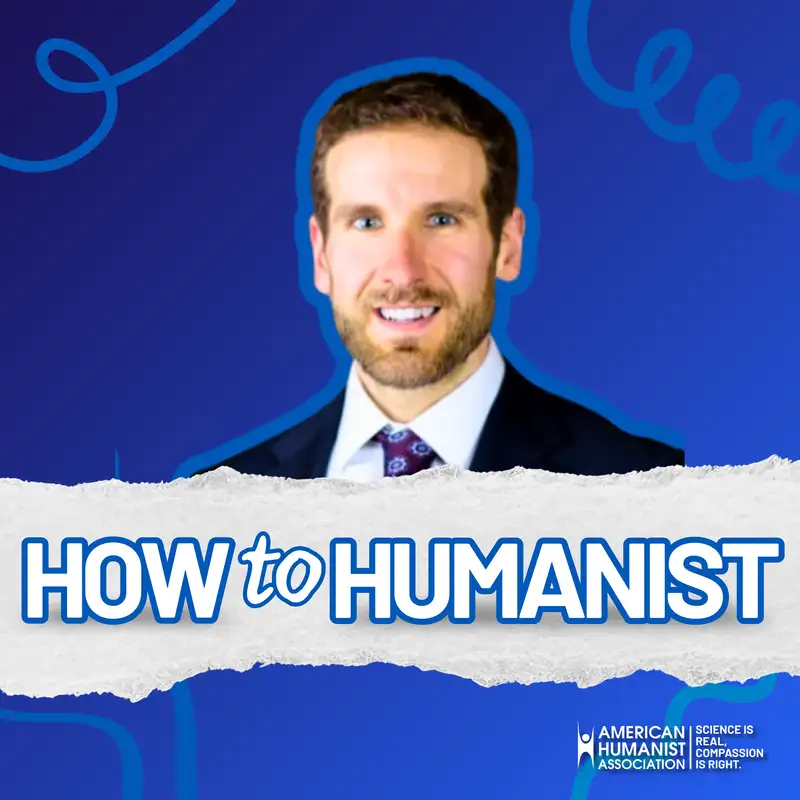
Today's guest is actually another neighbor of ours, Chris Line, who reached out telling me that he had a story to tell that I wasn't gonna believe he could tie back to humanism. So if you have dealt with any struggles around weight loss, with dieting, with self-image, anything like that, Chris's story is absolutely fascinating.
He began working at Freedom From Religion Foundation, which we will call FFRF, in 2015 as the legal intern while attending law school at the University of Wisconsin. Shortly after receiving his Juris Doctor in 2017, Chris began working full-time for FFRF as an attorney. He's an accomplished photographer whose work has appeared in The Humanist magazine, The Progressive, and FFRF's Freethought Today. In 2017, Chris began a weight loss journey, losing more than 270 pounds and maintaining that transformation ever since.
Please listen up to this episode, and I hope you enjoy.
SHAY:
I'm so excited. The day is here.
CHRIS:
Yeah. No, I'm excited too. This is very... I listen to a lot of podcasts, like maybe 40-plus hours a week, so...
SHAY:
Really?
CHRIS:
Yeah, but I don't really get to be on them really ever, so this is obviously very exciting for me.
SHAY:
Oh, I'm so honored. That's so cool.
CHRIS:
Yeah. Yeah, I'm also a big fan of AHA. I've worked with you guys a lot. I photographed the last convention in Chicago last year. I'm on the legal team here at FFRF, so I talk with Amitai, and I see Fish everywhere, all the time. Big...
SHAY:
Who doesn't see Fish everywhere?
CHRIS:
Big fan of both AHA and podcasts in general, so this is really the, I'm living the dream, I guess, today.
SHAY:
Oh, that is so cool. What a combination, to be a photographer and a lawyer.
CHRIS:
Yeah. I got into photography in college, and then my other fellow lawyer photographer, Andrew Seidel, who worked at FFRF with me, kinda helped me get into it, and then I just started doing it. FFRF started saying, "Hey, you're a photographer. Do you wanna take pictures for us?" So I did the convention, started doing all of our stuff, and then I branched that out to other conventions. I shoot Americans United's summit in DC. So it's an opportunity for me to go to other secular events without having to pay.
It really works out for me. I can go and take photos at events and still get to go. I've also done concert photography here in Madison, Wisconsin quite a bit too. So yeah, it's been a really cool hobby and one that has also provided a little bit of profit, which is always a cool thing when you can combine those two things together.
SHAY:
First I have to say, it's so funny that you bring up Andrew, because just moments ago I was on a call with him for the first time ever, so that's hilarious.
CHRIS:
Oh, Andrew's amazing.
SHAY:
Yeah. So unsuspecting too, because the background on his Zoom is just like, I could see DVDs and he seems like he's a music head. I've never met him before. And this is our first time meeting too, so I was just like, I wonder about this guy. So then sure enough, I Google him, and it's just like massive author about all smart things, and has debated Bill O'Reilly, and oh my gosh. I was just like, wow, okay. Intimidated a little bit.
CHRIS:
Yeah, he's been one of my biggest mentors. And I'm now in his office. It's now my office.
SHAY:
Oh, really?
CHRIS:
When he went to Americans United, yeah. So kinda literally filling his shoes, in a way. So yeah. But he's a great guy.
SHAY:
Are you self-taught in photography?
CHRIS:
Yeah. Yeah. I think most people are. I think most photographers don't really... I know you can go to school for photography, but I think most people, it's just kinda like you learn on the job really. Yeah.
SHAY:
Sheesh. That is incredible. Yeah. I'm just so intrigued by this.
'Cause Amitai, he's gonna have my neck for saying this on the podcast, but Amitai is an electronic music producer. And he's our legal director. So it's just the way that the pendulum swings on lawyers is just so funny to me.
CHRIS:
One of my coworkers, a lawyer, is an amazing pianist. Dan Barker, our co-president, is just the greatest musician I've ever met in my time. Like, he truly did religious music for children and had a whole bunch of CDs and stuff. Now he does freethought music, and he is phenomenal.
One of our legal admin people is in a band that I've shot here in Madison. It just, yeah, there's so many good musicians I always find in the movement.
SHAY:
Yeah. I just, I guess if I were to try to put myself in the shoes of somebody who has to color between the lines all day for their career, that I would naturally be gravitating towards some type of outlet that would allow me to just freak the fuck out however I want. And photography and the arts and electronic music production, that would be where it was at.
CHRIS:
Yeah, for sure.
SHAY:
So what's interesting about you coming on the podcast is you having no idea about my background, so I'm really excited about this topic that you proposed 'cause we'll get to dive deep. You have a really incredible story about having lost 270 pounds and how it relates to humanism.
CHRIS:
Yeah. Both in the sense of science and sort of human development, and also it really is just so deeply tied to my joining the secular movement in so many ways.
I grew up really overweight my whole life, just eating lots of processed food. We'd have McDonald's every week, and fried chicken, and just lots of food. I don't remember a time when I was a kid that I wasn't overweight, by a lot. Not oh, a few pounds overweight, just like extremely big my whole life.
My first real bout of successful weight loss and gaining control of that happened in college. I would do lots of walking. Even though I was heavier, I liked to walk a lot. Started getting into audiobooks. That's when I discovered The God Delusion and things like that. The God Delusion was a huge turning point in my life where I was basically always non-religious. But when I read The God Delusion, it was like it made atheism a real thing. I was like, "Oh, this isn't some passive thing about me that I don't believe in God." In our society and the way the world works, the fact that I don't believe in God is actually a huge, important thing about me, and it makes a big difference in my life and how I'm gonna live it.
And so I got into the Secular Student Alliance in college, and just while I was there, started to succeed in weight loss for the first time. I learned about health and fitness and was walking a lot more, eating healthier. I would play ultimate Frisbee with my friends. And so that all just kinda connected for me. Like, when I joined the secular movement was the same time I had this big bout of weight loss.
That ended. I finished college and left secular stuff 'cause I didn't have the college group anymore. Went back to my hometown working on doing oil changes on cars and just started putting on a ton of weight again. I was living with my parents, making minimum wage after having graduated college. Was just not in a really good place. And the weight got more than it had been before.
Eventually, I was able to figure out I wanted to go to law school. Got into law school. Lots of stress there. Kept piling on the weight, getting up to 400 pounds. But then, again, I found secularism once again.
Now, I knew the Freedom From Religion Foundation existed. I almost interned for them in college but didn't when I was involved in the secular movement. But my first semester at law school, I met Andrew Seidel in the lobby of the law school, talking about a potential internship there. I interned that first summer of law school. I interned the fall, winter, spring, summer, fall, winter, spring.
The career people at the law school were like, "You might wanna branch out with your internships. You may wanna try some different things. You don't really wanna put all of your eggs in one basket." It worked out for me. I ended up getting a fellowship at FFRF and then becoming a staff attorney after that.
But really, something about FFRF and about getting back into the secular movement, which had given me that first bout of weight loss, just it all clicked. Because June 1st, 2017, that's the day that I started full-time at FFRF as a lawyer, and that's the day that my weight loss journey, as I consider it, started. From that day, I lost 15 pounds a month for 18 months straight, and just the weight just fell off in a year and a half. Just incredible, and it's stayed off since then.
So something literally directly tied to the secular movement. So that's really the big connection.
But other connections are really just a lot of problem-solving and just using human ingenuity to beat myself, because that's what the problem was. It was always me against myself. There's something in my brain that wanted me to just eat food constantly, and I had to fight that. And for whatever reason, it gets to use all the faculties of my brain. I'm pretty smart. And so the same brain that I'm using to be like, "How can I avoid overeating and stop binging and relying on this dopamine hit of junk food to feel better?" The part of my brain that wants to do that has all the same tools, so it's like you're literally fighting with yourself.
I had to work through that. And then obviously other connections. There's a lot of misinformation in the health and fitness world. Lots of myths, mistruths, truths that are applied in an inappropriate way, stuff like that. You've gotta balance all of that out.
And really at the end of the day what worked for me was getting through the magical thinking and thinking there's some trick or something to it. Really it all, as with a lot of things, just comes down to science and understanding how your body works. And then once you understand that, you can develop the tools and things that you need to make change in your life. So yeah, it really ties in so many ways, my journey to humanism, atheism, my time in the secular movement.
SHAY:
Yeah. And I wanna be careful that we're not trying to imply that hey, if you become an atheist you'll lose the weight.
CHRIS:
Yeah. Yeah, it's not like that. No.
SHAY:
But that is one thing I do wanna work on, because I think for whatever reason it feels like there's this monopolization of the health and fitness area where there's a lot of religious people. But not just that, just a ton of conspiracy theorists.
CHRIS:
Oh, yeah. I listen to a lot of fitness podcasts where for whatever reason they understand the science of health and fitness, they'll cite studies, they'll be very scientific, and then they'll just start talking about the craziest myths and mistruths and pseudoscience. And somehow they're able to kinda capture both.
And so I personally just wanna take back a little bit more the health and fitness space to be like, actually, the people who are doing it right are doing it based on science, logic, and compassion and understanding.
But us humans, we're very human. I work very hard to do my best in terms of being as healthy and fit as I can, and even I do a lot of things that I know are not the healthiest choices. But it's just, you gotta make the choices that work for you. So that's another human aspect, is that if it doesn't work for you, it doesn't work for you. You could understand the perfect way to eat and live and whatever, but we're not perfect beings. We're flawed people just kinda doing the best we can, and I think that's what I always encourage people is like, "You have to do the best you can."
A lot of things about my lifestyle are really extreme, and I get good attention for that. This past week I had a Reddit post blow up again just because I happened to find the r/walking Reddit about walking, and people were speculating like, "How is it possible to hit 20,000 steps a day?" Right now I average about 30,000 steps a day, but back during my peak jogging time, I was hitting like 50, 60,000 steps a day because I would jog, which is very extreme.
So that gets a lot of attention, and obviously that's not something I would expect or encourage anybody to do.
SHAY:
Yeah.
CHRIS:
10,000 steps a day is a pretty common recommendation. I understand I'm extreme in some of these ways. I've learned to make it work in my lifestyle, and I do what works for me, and if it didn't work for me, I would not do it. And so I always encourage people like, "Hey, if you're looking to be healthier, fitter, look into what does that," which is really just more movement, eating less junk food. That's really the basis of it. But whatever it is, it has to work for you or there's really no point. It's very human in that way.
SHAY:
Yeah. So I wanna rewind all the way back. You, did you grow up in a food desert? What was... 'Cause I'm curious, because there are the families where against the parents' best efforts to get the kids to eat healthy, the kids are just picky eaters. And then there are the instances where the parents are busy and can't make a home-cooked meal, or there are financial limitations so they're having to eat fast food all the time. Or the whole family just makes poor decisions all together as a unit, and so they never really get exposed to healthier foods. Which one did you fall into?
CHRIS:
Yeah. I would say it was a combination of both of us making less healthy choices as a family, and just my own something about me was way more extreme. 'Cause my mom would make a lot of Hamburger Helper stuff like that, and I would eat too much of it. She'd let me buy whatever junk I wanted at the grocery store. I'd go to the grocery store and just buy foods that no person should ever let a kid have. Just like insane stuff.
Like I would eat this, either like pumpkin or like apple, I don't even know how to describe it. It was basically just frosting over like crumbs. Like just pure sugar and just not in any way real food. And so I dealt with that. And then yeah, we would have McDonald's as a family once a week. We'd have fried chicken once a week as a family. My mom was overweight growing up. My dad was not really, but he kinda ate the same foods, just less of them.
And the other thing is, when I grew up, it's a lot different now, but fast food was really cheap and affordable. Like right now we're going through this weird phase where fast food's terrible for you, and also just extremely expensive. Like a 400% increase over the past decade.
[SHAY interjects: Okay, let's get a little bit more granular about Chris's claims here. So according to KTLA, in 2026, they studied the 2014 price increases by chain. So let's go down the list. We got McDonald's prices doubled with an average increase of 100%. Popeyes average price increase of 86%. Taco Bell 81%. Chipotle 75%. And then for specific menu item changes, the McDonald's McChicken rose from a dollar to about three dollars, so that's 200% if you're calculating along. McDonald's medium fries rose from a dollar fifty-nine to three seventy-nine. And Chipotle guacamole rose from a dollar eighty to two ninety-five. Hot damn, 64%.]
CHRIS:
Like, when I was young, there would be coupons on the back of receipts from the grocery store for like, buy one get one free McDouble or something from McDonald's. So for a dollar I could have two cheeseburgers. I could buy a drink for a dollar. For three or four bucks I could have a meal that was just way too much food for what you should be eating. Now that same type of sandwich costs you 12 bucks. So it's not even an option for people who don't have the means to buy other food.
So yeah, it was a combination of that and just ignorance and not understanding. Obviously I knew intuitively and was taught through school about healthier eating, but it just was never a consideration that I would ever actually do it.
SHAY:
Was it appealing to you at all? If you saw a piece of broccoli, were you gonna eat it, or were you like, "Ew"?
CHRIS:
No, not at all. It was gross. Like, I just wouldn't try it, wouldn't try vegetables. All the food I ate was processed food. And it's designed that way, unfortunately. So there's one thing I talk about, that science actually was a big part of causing me to get severely overweight, and it also has been part of my redemption and getting out of that.
These over-processed foods are designed to do this. They're designed to be not filling. They're designed to give maximum dopamine reward. They're designed to make you crave them. They're designed to make you want chips and a burger more than broccoli and fruit or anything like that.
And then you add in the fact that our system's set up in a way where those tend to get their costs reduced, making them cheaper and more affordable for families, and it's just a recipe for why we have 70% of the country either overweight or obese.
Which causes just the big thing for me, the suffering. A lot of people suffer because of that. You go through health problems you don't have to go through. And so that's a big part for me, is just like, I think as a part of humanism we're looking out for, "Hey, let's save the planet. Let's stop pollution. Let's make a better world for all the people." And I think I just really wanna help people turn inward too and say, "How can you make better choices about yourself?"
'Cause I think that we get so bogged down in the fight for separation of church and state, fighting pollution, fighting the terrible things our government's doing, fighting Christian nationalism. That gets so stressful. We get so bogged down in that that sometimes we forget to fight for ourselves and to take the actions we need in our own lives. And I get it. I get stressed, and it causes me to search out bad foods and things like that. Sometimes that dopamine is just necessary to get through the day.
And I've struggled with that the whole time. That's the thing that I think is interesting I like to share with people, is that it didn't end. That year and a half where I lost the weight was the beginning, not the end.
Maintenance has almost been worse or harder in some ways, because when you wanna lose weight, it's really easy to just say, "I should just try not to eat pizza." It's like, I really need to lose weight, I weigh almost 500 pounds. It's an easy decision to just say, "I'm just not gonna eat pizza for a while." But when you get down to maintenance, you get to a healthy weight, now suddenly it's like, okay, I can have pizza sometimes.
And so the problem is, what is sometimes? Can I have it once a week, once a month? Probably not every day. So you get to a place where now you have to make decisions, and that's where it gets hard. Whereas with weight loss, it's just like, I'm gonna try not to eat cake or sweets or anything while I try to lose this weight.
And so that's the real challenge. And the thing that's most important is lifestyle and sustainability. That's what I always go for. So like right now in my life, I eat very healthy, but in a way that I love. I love every meal I eat. I love every day, and I don't have a desire to seek out junk food and things like that.
So for example, one thing I bring up is that if you told me the world was gonna end tomorrow or I was gonna die tomorrow, I'd still eat the same healthy foods I have planned today. I wouldn't be like, if it's over tomorrow, I'm gonna go to McDonald's tonight. I just have no desire for that because the healthy foods I've incorporated into my life, I enjoy them as much as I ever loved getting three burgers at McDonald's and a big thing of fries and a shake.
As much as I loved and got the dopamine rewards from that, I've been able to rewire my brain to where I wake up in the morning and I have a big bowl of overnight oats with some almond milk, a little protein powder for flavor, and then just a ton of fruit. I'll throw some strawberries and blueberries in there. It tastes like dessert, but it's much healthier than eating some of the foods I would eat previously.
And so there are things like that. I don't wanna in this conversation go through every tip, I could spend hours and hours talking about the specifics. But really I think the big thing to point out is just the mindset of, hey, every single person can make healthier choices. Not everyone can devote their whole life to health and fitness the way I have, but you can add a 15-minute walk every day. You can choose a slightly healthier option with your food. And what I found is it's just really easy. That just rolls. As you start to do it, you can't help but do more.
There was a time in my life where I thought I was gonna have a full sugar Coke every Saturday. That was my lingering habit that, even as I changed a lot of things, every Saturday as a treat I'd have a Coke with my dinner. I thought that was gonna have to continue forever. I was so addicted to it. And I was able to get away from that, and now I don't.
And same thing, I vividly remember I'd still on Saturday have what I call a cheat meal. I remember standing in line at Taco Bell on State Street here in Madison, and it would take 45 minutes to get my food. And it just occurred to me, like not only would it take the same amount of time for me to make some taco meat at home with some lean ground beef, but when I actually went ahead and did it, I found that I enjoyed it more. I take home taco seasoning, lean ground beef, some lower calorie taco shells, make my own tacos at home. Less processed. It took the same amount of time as waiting in line for the Taco Bell, and I was just like, "Oh, I don't actually have to have this Taco Bell."
But there would've been a time where if you'd have told me I eat vegetables every single day and love it with some hummus dip, I wouldn't have believed you. 'Cause it does take some time for your brain to rewire when you're so used to processed food and the dopamine hit and just the way it's wired.
But you can change. That's the big message. It's not gonna happen overnight, but I just wanna encourage more people to try. And then you just see how far you can get, and if it's as far as you can get, that's the best you can. I think it's very human to just do... I just think people need to just do the best they can, and if you're doing the best you can, that's the best you can.
SHAY:
I think that's something people don't often consider. 'Cause I have a background in the restaurant industry. I spent 13 years as a waitress and it was in corporate restaurants. And what people don't get to see, especially if they don't work in the restaurant industry, is how these corporate restaurants will have a grand opening, and everything will start off great. The quality is highly invested in. Every plate is touched and looked at and wiped, and everything is pristine, and everything goes out to the table, and it's perfect.
But after month three, then corporate suddenly says, "Okay, now we have to look to drop costs. Where can we get cheaper quality meat, cheaper quality this, cheaper quality that?" That is across the board for all corporate restaurants.
So what I will say is if anybody can take away anything from this conversation is, where there is gonna be an alternative, that if I have a craving or a hankering for something that I can go support a small-owned, preferably family-owned business, I will go do it.
If I can go into an Ethiopian restaurant where the mom, the dad, and the son are taking care of me with smiles, where the mom is in the back feverishly cooking up the shiro wat, I'm supporting them because they care, and I know it's gonna help them sustain this life that they've built. Because the quality is not going down, and you also avoid all of the crap that's going into the shit quality that they're putting into some corporate mass-produced thing. It's a very real consideration to make.
CHRIS:
Yeah. No, I think that's huge. Especially now that, like I said, fast food, if you wanna take your family out to McDonald's, it's gonna cost you the same amount as going to a restaurant now anyway, so go to the restaurant.
But that's been a big thing that I've utilized too, is just, if I'm gonna have a more calorie-dense food, I just want it to be really worth it. A meal from a nice restaurant, totally gonna be worth it even if you're eating a lot more calories than you might want for the day. Totally worth it. But don't waste that on some junk food or some crappy pizza that's been sitting in the gas station light for two hours.
SHAY:
Oh, my God, those...
CHRIS:
It's not even good. You know? You're getting your fat and salt triggers for your brain, but it's not really something enjoyable. And so you're gonna end up hurting your health and not getting anything out of it. Whereas if you're gonna have a higher calorie, fattier food, make it worth it. Get something really nice.
What I've done is I just always try to eat as healthy as I can in my life and diet, because I've found that the unhealthier foods will find their way to you. So like for example, I work at the Freedom From Religion Foundation. We'll go out to get pizza. Members will buy us pizza. We'll go out for a lunch. The interns are coming in a couple weeks. We're gonna go out to a restaurant and stuff. And so I just save my going out to a restaurant for when it comes naturally in my life, as opposed to deciding to go out on a Monday night for no reason and order a pizza.
That's how I tried to manage it, is I'm not gonna turn it down if it's brought to me. If we're having pizza at work, I'm not gonna be like, "Oh, I'm not gonna have that." But I don't then also incorporate a lot of that into my normal day-to-day diet, and then that's how I'm able to kind of balance things out.
SHAY:
Yeah. It's so disappointing to me that my downstairs neighbor, lovely person, she is a kindergarten teacher, and she constantly brings me home these bags full of these smaller little baggies of vegetables that are supposed to go to the kids at lunch that they never eat. And I just shove them in my freezer and I keep them for a rainy day when I need to make a little roasted veggie something or other. But as happy as I am to have them, I'm also frustrated that these kids today, what's the matter with kids today?
But I just wish that they were more receptive to eating well. Because I'm very fortunate that I came from a background of my mom making wonderful meals, and because I had older siblings, 12 and 16 years older respectively, I was never gonna be eating a kid's meal. I was always gonna be eating whatever the family was eating. So I didn't ever eat beige food. I was always eating very colorful food. And so it's very hard for me to see kids today who will only eat chicken nuggets and fries 24/7.
CHRIS:
Yeah. No, I'm very alarmed. And I grew up that way. I mean, we had whatever the school lunch was, which unfortunately was always just pretty low quality food. But then once I hit middle school and high school, we did this thing where there were a la carte options. And I remember spending a lot of money that my family didn't have on junk food 'cause it wasn't regulated very well. So it's like they could put money in my account, and then I'm buying french fries. I can have my meal for school and then buy french fries. And we had candy available.
This changed a little bit towards the end of my high school time. We had vending machines with soda that eventually got switched out for only sugar-free, I think. But yeah, it just was so available. When I was in high school, we could leave for lunch, so we could literally drive to McDonald's and stuff. Yeah, it's really concerning, and it's just getting worse. We're just having people have more and more weight issues.
Now, there are other scientific things coming out that I think could make a huge difference.
[SHAY interjects: Okay, Chris is about to talk about GLP-1s, and I know that you might have feelings about that, but I'm gonna encourage you and ask you to be open-minded because Chris is about to address a lot of the realities of being somebody who might need a GLP-1, and we talk about the celebrity culture around it. We talk about food noise and everything that you would need to know. So give it a shot. Listen up.]
CHRIS:
Like the GLP-1s are huge. I think they could make a gigantic change in the world. I'll tell you.
So my big problem is I have an insatiable appetite. Unfortunately, I'll never know what that came from. I call it the chicken or the egg problem. I don't know if I was born quote-unquote "normal," and because of my diet growing up it did something to my brain that made it this way, or if it was an inherent thing that even if my parents had tried to raise me with healthy eating, I still would have felt this way.
But all I know is my appetite does not end. True probably of any person who's gonna end up almost 500 pounds, ending up in that My 600-lb Life territory. I just could always eat an unlimited amount of food.
SHAY:
Yeah.
CHRIS:
And that still happened after I started the weight loss. It just never, it's never gone away. And your body fights you to try to get back to where it was. So that's been a lot of my big struggle, is even if I'm able to resist it...
So like at FFRF, we'll have food come all the time, and so my choices are I'm gonna go overeat the food that's brought in, the pizza, donuts, bagels. I'll eat like four or five bagels or something insane. The problem is, even when I'm able to resist that, it just messes up my whole day. Because I'm like, even if I didn't eat a whole bunch, even if I didn't overeat the donuts or whatever, my whole day was sitting in my office trying to work, trying to defend the separation of church and state, and just thinking, "Oh, there's donuts over there. Oh, I shouldn't get 'em. If I have one with lunch, am I gonna be able to stop myself from eating three more after that?"
SHAY:
It's obsessive.
CHRIS:
Yeah, and it's not a phenomenon that happens with apples or broccoli. I've never eaten a head of broccoli and been like, "Oh darn, I'm going back for six more heads of broccoli and I'm gonna eat it all." It's only with these ultra-processed foods. But if there's a tub of ranch dressing over there...
SHAY:
Oh, yeah. Yep, exactly. And it's designed that way.
CHRIS:
And so this has been my issue. And so the way I've managed it is I keep those foods away from me. I have to buy peanut butter in little packets, because if I have a jar of peanut butter, I will eat a half a jar of peanut butter a day. I've had to just avoid having sweets in the house, just keep healthy food options, stuff like that.
And then the other big thing is just, like I said, the jogging. At my peak I was doing 15 to 25 miles a day probably, sometimes as high as 30, every single day. And that extra burned calories would allow me to eat a comfortable amount to where I could do it. But even on top of that, I would add a bunch of vegetables every day to be able to manage. So I'd have to have my normal breakfast, and then eat a head of cauliflower just to fill my stomach up and have some chance of stopping myself from eating.
But interesting turn of events. In December, I broke my foot. I'm not sure exactly how, but I had real concerns now that I'm not gonna be able to exercise as much about how I'm gonna manage this without putting on a lot of weight. My doctor suggested I try Zepbound, which is tirzepatide, a GLP-1. I took it, and it just instantly changed everything for me.
That thing in my brain that says, "Eat, consume, you need to eat more," the food noise, stopped like right away, and I felt normal for like the first time in my life. Now, that waned a little bit after the first couple weeks. It's not quite as strong. But for those couple weeks, I don't know, I just realized that there's something fundamentally broken inside my brain that is making me, that is driving me, some biological drive.
And my doctors talked to me about this, that my body's always gonna use whatever it can internally to try to make me consume more and to get around my defenses. And even with the GLP-1s, we've learned a lot of companies are working to beat them to make their products, their junk food, more addictive to get around people trying to use this.
SHAY:
Wow.
CHRIS:
Which is crazy. But anyway, I've been on it now, and I've stopped. Now I walk. I'll still walk 10 miles a day just 'cause I enjoy it. And it gives me a chance to do my podcasts and things like that. But I'm living a much chiller lifestyle than I was, and I'm much more able to control what I eat, and in particular, to control the cravings.
So now I can plan out my healthy meals for the day, and then I don't need an extra thousand calories on top of it because I can't stop myself from eating some of my girlfriend's chips in the pantry or whatever. We had donuts yesterday at FFRF. I didn't end up eating any of them. I just wasn't hungry for them. And there was no mental fight. I wasn't sitting there in my office all day like, "Oh, how do I stop this?"
So I think the big problem right now obviously is the cost is way too high for these drugs, and they're trying to lock them down. And they don't work for everyone, which is another unfortunate problem. But if we can find a way to make these affordable for everyone, there are some people who have side effects and we just wanna make sure it's all safe, but I think things like this, scientific interventions, could make a huge difference in reducing the number of people who are overweight or obese and just improve the health of Americans.
And especially for people who have a severe issue like I do. It's not necessarily a thing for people who, oh, they gained 10 pounds over 10 years because they just like to eat a little more. But for people with severe issues like I have, that for whatever reason drive them to an extreme of eating, it could be a revolution in helping people and treating people with that.
SHAY:
I'm so glad that you're broaching this topic because for anybody who's still listening, hopefully open-minded enough to continue listening to this portion.
CHRIS:
Yeah.
SHAY:
GLP-1s, the connotation is so well associated with celebrity culture, capitalist culture, that there are just probably people up in arms right now. Can you address that a little further?
CHRIS:
For sure. So I'll say one thing. That's one of the main reasons why I have sort of evangelized now in GLP-1s, is because there's this unnecessary shame with it that both is an internal thing and definitely an external thing, where people are upset with people for cheating.
Here's the thing. It's only cheating if you view your weight and your health as a competition, as though, "Oh gee, someone's getting ahead of me. Your weight and your body is a competition and if you're using a GLP-1 to be healthier, then you're getting ahead of me." Here's the thing, it's not a competition. It's a competition with yourself to live a better, healthier life. That's all you need to worry about. You shouldn't be worried about if other people are getting healthier. It should not alarm you if the world is getting healthier, because they're somehow better than you.
Because I don't think... I wasn't a bad person when I weighed 450 pounds. I'm not a better person now. I'm actually a very similar person, I just make different choices. And so it's not a competition. You're not cheating. It's just a way to help you.
And we've seen that people are not dealing with the same thing. Some people think they are, so they'll be like, "Oh, I don't understand. We have donuts at work and I can eat one and then I don't wanna eat any more. Like why is it such an issue for you?" I think people struggle to put themselves in other people's shoes.
But because I lost the weight the quote-unquote "right way," and for me the quote-unquote "right way" was like a ton of exercise and having to take tons of serious interventions in my life to prevent myself from overeating, and it really was a struggle, and a struggle that a lot of people aren't gonna be able to do, both because of time, I put an insane amount of time into it, and cost, I eat a lot of alternatives, lower calorie alternatives to food. They're just very expensive, and luckily I have the finances for that, but not everybody has the money to buy cereal that costs three times as much because it's made up of more fiber and protein than regular cereal.
So I've been extremely lucky and have a ton of advantages and privileges in those ways, and I recognize that. And so because of that, I think I wanna be the one to talk about it, because there are people who feel more shame for taking a GLP-1 who are never gonna talk about it. I feel like I wanna break the stigma and just say, "Listen, this is a tool that helps people."
And yeah, it can be problematic. Like I said, it's not for someone who is five pounds overweight and wants to lose five pounds. That is not what it's for. It is a serious tool for metabolic disease. And that, that tends to be the issue with a lot of celebrities. Is that they feel pressure as celebrities to be even thinner, and so they do it. Obviously, there's a lot of risk for people with eating disorders to try to get on these things, and that's a big issue.
But yeah, it's not a free-for-all. These are drugs that are prescribed and should be in consultation with your doctor, and treated as medical interventions, not as something that people are just grabbing off the shelf and being like, "Oh, I kinda wanna lose a few pounds." They're very serious interventions.
And so yeah, there is a lot of stigma because of that, and because of celebrities using it to lose that last 10 pounds and to be way skinnier than they need to be.
I wanna emphasize the morality. That's a big thing I wanna emphasize to everyone. I don't think there's anything wrong with being overweight. In my life, I was overweight way more than I was a leaner, healthier weight, and it's just not a moral thing to me. I don't think there's anything moral about it. It's just a practical thing of, hey, if you are able to reduce some of your fat, you're probably gonna suffer less health consequences, probably live a longer life. There's a lot of good benefits to it, and I think no downsides to just making healthier choices. That's kinda where I stand on it.
But I try, in these sorts of platforms, to evangelize it. For me, it's very similar to how I feel about atheism and religion. To any individual person who's religious, I'm not gonna go up to you and be like, "You need to lose your religion." I don't care on the individual level. I don't care what people believe, and they can live their lives how they want. My issue is that the majority of people believe in religion in this country, and it's caused a lot of problems for people. Believing things that aren't backed by science, evidence, and understanding has caused big societal problems. So that's why I, as an attorney at FFRF and as an atheist, will stand up on public platforms and say we need to do something about misinformation, try to educate people. But I'm never gonna wanna fight with someone on the individual level about religion.
And I feel the same way about weight. If you're overweight, I'm not gonna go up to any individual person and be like, "Hey, you don't have to live this way." I would never do that.
But on a platform like this, where I can send it to a lot of people in a way where I'm not targeting you, I'm not making anyone feel bad or stigmatized, hopefully I'm just saying, "Hey, there's a healthier way, and most importantly, you can do it, and you will eventually feel good about it." I think that's the big hurdle to get over, where you're like, "I just couldn't imagine myself taking long walks every day and eating healthy. Eating broccoli for lunch just sounds terrible to me." And the thing is, once you look at it, you will.
I think very similarly, once again, it ties into religion. A lot of people, once they've left religion, are like, "Holy crap. The things I believed, the things I let people tell me, the things I let people do to dictate my life, were crazy." But at the time they couldn't have imagined living any other way because they were so caught up in religion and stuff like that. It's the same way. When your brain is so hooked on junk food that has been built and designed in scientific labs to make you feel this way, to make you feel like you never wanna stop having chips, what would life be?
I have people see in the criticism I get of this, "Oh, don't you want cake? Isn't cake awesome?" And yeah, it is great, but for someone like me who can't just have a piece...
I think there are a lot of people who their ideal version of life can look like having cake once a week, and they're able to eat that piece, enjoy it. There are people like that. For those people, moderation is a perfect technique, and that's how they should seek to live their life. If you can moderate and you can have a little bit of pizza, have a little bit of cake, and it doesn't consume your life and drive you to make lots and lots of more bad choices.
And the same thing, I think some people can relatively relate it, instead of food, to alcohol. There are people who can have a drink or two on Friday night and are perfectly fine. There are people who, if they have a drink or two on Friday night, are gonna spend every day drinking and become alcoholics and ruin their lives. There's no universal principles for everyone, and that's how it is with food.
So people try to preach moderation. Moderation only works for some people. It doesn't work for me. I'm just not a person who can have one donut and move on with my day. That is a little bit different now with the GLP-1, and so that might help turn more people into the type of people who can comfortably have a little bit of sweet treats here and there and not overdo it.
But that's what I'm saying, it's really about finding what works for you and experimenting and figuring out, are you the type of person who can have a little bit of that, or are you the type of person who really needs to find a different alternative to incorporate into your life instead?
And I don't want anyone to feel shamed or bad. And hopefully I didn't do that already and they turned it off, because that's my fear. And it's the same thing as being an atheist. I wanna convince people that they can have all the good things from their religion, like community, curiosity, trying to understand what we're here for, what our lives are about. They can have all of that without needing to believe in magic or without a lot of the hate that can be indoctrinated through religion.
You can have it all, and it's just hard that if you say, "I'm an atheist," people are like, "Okay, cool, I'm not gonna talk to you," and so now you can't even have a conversation about it. And same deal, if I say something that's gonna deter someone from even entering a conversation about how they might seek to change some of their habits, that's a big fear I have, because I just want people to just try to do better. That's always my thing, is just try to do a little better every day.
And once you hit a point where you're like, "Listen, I'm doing the best I can," just get specific with that. Like for example, I drink way too many energy drinks. I do sugar-free, I don't get all the excess sugar. But I know drinking two energy drinks a day is not the healthiest choice for me. But it just is a thing that is a staple in my life that allows me to live my lifestyle. It allows me to avoid having worse options.
And so it's stuff like that where it's like, you're never gonna be perfectly healthy. But you gotta find what works for you and just incorporate that.
SHAY:
What you were discussing earlier, what's interesting about the correlation between weight and religion, is that, and this is obviously not across the board, but there are many people who have decided to use weight as a shield, even subconsciously, to mask the shame that they have built up around how religion might have made them feel about potentially being gay, or maybe a sexual assault that they've experienced that was not taken seriously by the church. There are just so many different stories that I've heard just from how religiosity compares to people who have gained weight in this way just to wall themselves off from society and to isolate themselves. And it's sad. It's really sad because I would want the same for those people to be able to let go of that shame.
CHRIS:
Yeah. I agree, and I think that is... a lot of times weight gain comes from trauma. Whether that's religious trauma or another one, it's just us coping. And there's a lot of unfortunate things tied to it that are different than other things. If you have an issue with alcohol or hard drugs, people will tend to feel a little more comfortable confronting you or doing something or helping. You know, like it's considered more of a problem.
Whereas I was suffering real issues. There's a reason why I was up to 450 pounds, and people don't really try to intervene. There is this stigma of, it's not the same thing. If I were drinking alcohol all day, every day, I think people would've done more. Whereas if I'm eating fast food five times a day, people don't interfere in that. It's just a whole different situation.
SHAY:
Well, what can you do? What's an appropriate interference?
CHRIS:
Yeah, I don't know. I guess if they were close to me, less than focusing on the weight, focus on the issue. Say, "Hey, is there something going on in your life you wanna talk about?" And just not make it about weight, make it about trying to get underneath that and see if you can find out that they have some religious trauma and whether there's some way to help with that, I guess, would be the only speculation I have. But yeah, that's an issue.
SHAY:
Yeah.
Now, I wanted to ask you, because you and I both lived through the glorious time of the '90s and the 2000s. The time when fatphobia was just wreaking havoc everywhere. What was it like for you to be fluctuating in your weight during that time?
CHRIS:
I've always felt shame for my weight. But honestly, for me, when I was a kid, I got a lot of bullying, as happens with kids. As it went on later, a lot of the shame came internally. And like, for good reason sometimes. For example, this is something I share. I've probably broken like eight, nine chairs in my life.
SHAY:
Wow.
CHRIS:
As in, I'm out in public and you sit on a chair and it just can't handle it. That happens when you weigh like 450 pounds. And that sucks. And so that's less fatphobia and more just the practicalities of having to live with that. And one of the reasons why I try so hard to try to help people now is to know that they don't have to deal with it, to avoid those things.
But like I said, I'm not a huge fan of the idea of fatphobia or in some way targeting or judging people for their weight, because there's always a reason. There's no person who's living a perfectly happy, great life and everything is going perfect, and they're able to get up to 500 pounds. There's always something in there, whether that be mental, emotional trauma, or biological. Maybe they really do feel happy, but something in the brain is not connecting correctly and is causing them to overeat.
I'm not a fan of shaming people for their weight. On the other hand, I don't fall into fat acceptance in the sense that I think we should treat people regardless of their weight with respect. But I do worry when it gets to the point of almost glorifying weight or in some way encouraging people to stay heavy or to be heavier. That's where it becomes a problem for me.
I definitely accept fat acceptance in terms of, "Hey, let's stop being jerks to people who are overweight." Totally on board with that. No question. But I do worry in some of those spaces that it does go too far. But that happens with any movement or something. There's gonna be extremes that push too hard in the other direction.
So it's complicated. All this food stuff is just complicated because we all have to eat food. You can't avoid it. It's not like certain addictions where you can just be like, "I'm addicted to alcohol, so I don't go to bars." You can't go cold turkey. You can't just avoid it the rest of your life. So you have to learn to manage it.
Luckily, there are a lot of techniques. I've learned thousands and thousands of tips and tricks that I have to utilize every day. And what's nice is once you learn all of them, you can adapt to situations. Every time I change, like if I move to a new place, go somewhere with different food options, I know all the tools and stuff to do that. And that information's out there. So I think that's the hard part, recognizing and prioritizing your health, and then you can wade through the misinformation and lies.
The thing is, a lot of stuff works. It just shouldn't be the sole tool. People will be like, "Low carb." Yeah, low carb will help you lose weight. And I've used it as a very effective tool. Intermittent fasting will help you lose weight, used as a tool. But you have to know when to do it, how to do it, and to do it in a practical way that fits with your lifestyle, 'cause anything you can't do forever is not gonna be that useful for you.
So that's always been my thing. I set up my lifestyle in a way where I can do it forever if I want. In terms of fasting, it'd be like eat dinner at 5:00 or 6:00 o'clock and don't eat again till breakfast, which was the original, like break fast, that's how that word comes from. That's how I would utilize fasting, not some crazy 24-hour "I only eat every other day," which is not gonna be sustainable for most people.
Low carb, I think low carb is good because for a lot of people we're sitting a lot. We live a very sedentary lifestyle. So you don't necessarily need to get all of your calories from carbs, which are the body's preferred energy source. Switching to more protein and more fats can be really good because you just don't need that buzz of energy and sugars all the time. But you don't need to take it to the extreme of keto, where you're eating basically no carbs, because your carbs are your body's preferred form of energy and it just is in everything. So the carbs will just find their way in because everything just kinda has carbs.
So really that's where the misinformation comes from, is that all of these things can be useful. Eating more vegetables is great. You don't have to go full vegan or vegetarian, but the more vegetables and plants you can get into your lifestyle, studies show the healthier you're gonna tend to be.
So there's lots of studies and science out there explaining stuff, and you just kinda have to wade through the misinformation and disinformation, start to apply that, and then once you learn that... I think the biggest thing I'd emphasize though is just getting away from the processed food. Whole foods are gonna help most people, and you're not even gonna struggle because you just can't eat as much of them. So you're gonna feel healthier and happier. You're gonna be able to eat a lot less calories of fruits and vegetables than you would of chips and candies and things. So you're naturally just gonna not put on as much weight while still getting to eat a lot of food.
Like I said, the way I've been able to do it is I still eat a ton of food like I did back when I was overweight, except it's much lower calorie than it ever was.
So then another tip and trick, I eat a lot of ice cream, except it's high-protein ice cream that I make myself.
SHAY:
Oh.
CHRIS:
So there's a thing called the Ninja Creami. Basically what it does is you take a protein shake, you freeze it, and it uses this paddle to turn it into ice cream, and it tastes just like ice cream except it's high protein, low fat, low sugar. And so I eat those two to three times a day, a pint and a half of ice cream every day. And it's only like 250 calories.
SHAY:
I am getting me one of those.
CHRIS:
Yeah. We can talk more. I'll send you some info about it.
SHAY:
Yes, please.
CHRIS:
I've been selling a lot of these. I don't get paid by them. It's not promotional. But it truly... Stuff like that, where it's like, "Hey, now because of science, I'm able to have ice cream multiple times a day except for one-fifth the calories of having a pint of Ben & Jerry's."
SHAY:
I can put my chocolate tahini sauce in there. Okay, sorry. I'm like, the fantasy's already starting.
CHRIS:
Yeah, that would be good. And yeah, I do a lot... And that's why I had said earlier that science helped make me fat and it's helped bring me back.
So I eat a lot of artificial sweeteners, which are zero calorie but make things taste good. If you're the type of person who can drink just water as your primary drink, that's the healthiest thing for you. You should do it. I've never been able to do that. My brain just can't do it. At a restaurant I can get away with a glass or two with my meal, but I've got a Brita pitcher, I try my best, I can't do it. So what I do is I drink artificially sweetened flavored waters, and it tastes amazing. It tastes like juice, but I drink that and it's mostly water. It's like 95, 98%, it's just essentially water for all intents and purposes, except it tastes delicious. And so I can get myself to do it. And so I have that every day for 10 calories for a giant bottle, versus soda or something that's gonna be worse for me.
I have a lot of swaps like that where I eat an artificially sweetened version of a food I used to eat, a lot of high protein snacks and stuff that can sub in for that. Those are like little tricks and stuff. So it's just stuff like that. If you learn about that, you can live a lifestyle very similar to the one you have, except you implement these little tricks, and then suddenly you don't have to deal with the health consequences of it. And that's through science and understanding.
SHAY:
I think one of the mantras that I started coming up with a few years back was doing my future self favors. And one of the things that I started in January 2025 was I got this 35-ounce water pitcher because I was walking around like a shriveled little raisin, just dehydrated 24/7. And for over a year now, I've been drinking over 100 ounces of water daily, nonstop. And so now I'm just so grateful that water is no longer an issue for me.
But what is an issue that I'm so excited, Chris, to now keep you in the loop with as I continue to explore it, because I'm in hot yoga several times a week and I'm in the gym and trying to get my weight manageable, but I am as a vegan having such a hard time getting enough protein in.
CHRIS:
Yeah.
SHAY:
And I hate saying that too because I was always like, everybody was like, "Oh, you're a vegan? You're gonna have a hard time getting protein in." And I'd always be like, "Fuck off." And now I'm literally having such a hard time getting protein in and I'm like, "Damn it." So.
CHRIS:
And unfortunately protein is one of the most important things that you can have. And I've always said too, I honestly would have an easier time going full carnivore and eating solely meat than I would going full vegan, because I just, you know, a lot of chicken. But there are things, I'm sure you've learned, like lentils and a lot of foods that do that. There are obviously vegan protein powders and stuff.
Stuff like that. This would be a good trick for you. Some of the best protein ice creams I make are with this vegan protein powder that I use, because for whatever reason it hardens more. Same thing when I put it in my overnight oats.
I'll throw some of that info your way after. And I can share more of the tips that obviously I didn't wanna bog down listeners with on the individual tips. Wanted to focus more on the why than the how. But we can talk more, and I can talk with you more about that just to help out.
Because yeah, that protein's big. Like you said, strength training is huge in terms of health, even more so than cardio. You're way better off lifting weights than you are running in terms of your health.
There's just so many things that you kind of learn over time.
SHAY:
Yeah, I'm just gonna be objectified when I walk down the street. That's my goal.
CHRIS:
Yeah.
SHAY:
Yeah. Chris, I can't thank you enough for coming on. This, I was really like, Lord, I was like, how is he gonna relate this to humanism? And now I'm like, environmentalism, critical thinking, like all of the above. This is just now so apparent to me, so thank you 'cause that truly opened my eyes.
CHRIS:
I mean, weight, health, and fitness, the problems are all human-based. 'Cause we know what to do. People know what to do. Eat less, exercise more. Oh, how come we're not all fit and healthy? We know how to do it. Because of the human aspect. Because we're human, we're flawed, and we have to figure out ways around those flaws if we wanna live a better life.
Thank you so much for giving me this opportunity to talk about this. Of course. I know it's something, it's been a big part of my life for the past 10 years, and I don't get to talk about it enough. I tend to focus more on my work protecting the separation of church and state through the Freedom From Religion Foundation. So it's nice to have an opportunity to come on with, as I said, I'm a big fan of AHA, and to come onto your podcast and to talk about this aspect of my life has been great, and I really appreciate it.
SHAY:
Thank you, Chris.
Listen to How to Humanist using one of many popular podcasting apps or directories.